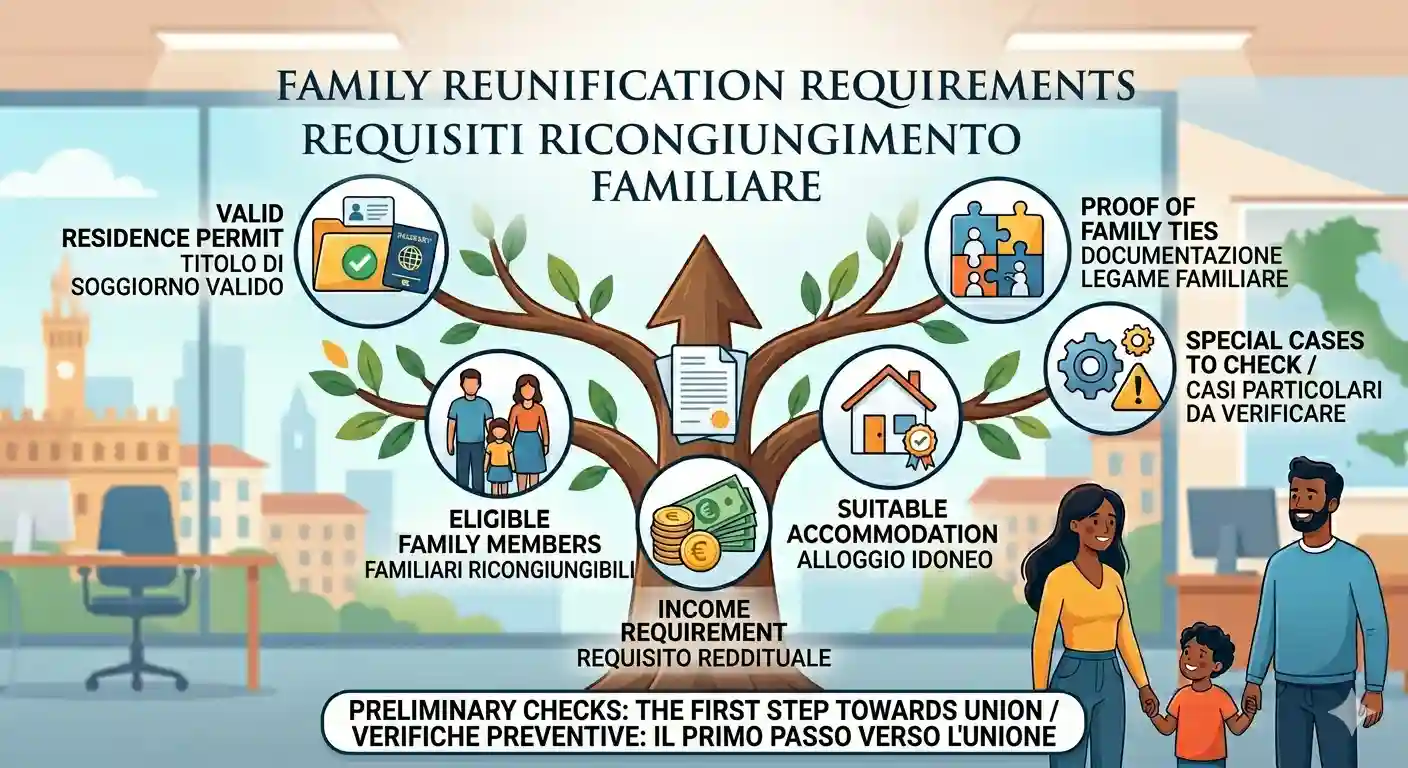
Before starting a family reunification procedure in Italy, it is essential to verify that all the conditions required by law are actually met. The requirements for Italian family reunification do not concern a single aspect, but a combination of elements that must exist simultaneously and must be carefully checked before submitting the application.
The profiles to examine are the following:
- the type of residence permit held by the applicant
- the categories of family members who can be reunited
- the income requirement
- the availability of suitable housing
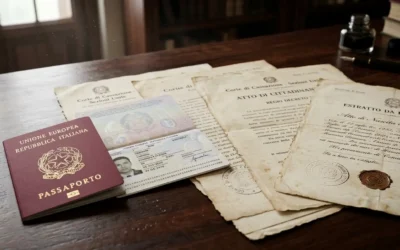
- documentation proving the family relationship
- any additional conditions required for specific situations
General framework
Family reunification in Italy is governed primarily by Articles 28, 29, and 29-bis of the Consolidated Immigration Act (Legislative Decree No. 286/1998). Verifying the requirements does not involve a single element, but a combination of factors that must all be present at the same time.
In practice, the most common mistakes arise precisely here: applications are submitted without having properly checked one of the prerequisites, or with formally incomplete or inconsistent documents. Applications are blocked — through requests for additional documentation or outright refusals — not because the right does not exist in principle, but because one of the requirements was assessed inaccurately or documented incompletely. A thorough preliminary check, carried out before submitting the application, is the most effective tool to avoid unnecessary delays and increase the chances of a successful outcome.
The residence permit
Family reunification may be requested by a foreign national lawfully residing in Italy who holds either a long-term EU residence permit or a residence permit of at least one year’s duration issued for employed or self-employed work, international protection, study, religious reasons, or family reasons.
The verification does not stop at the type of permit. It is also necessary to check the remaining validity of the permit, the continuity of lawful residence, and the category of the family member to be reunited, since the applicable legal framework may vary depending on these factors.
How long must you have lived in Italy before applying
For certain categories of family reunification, holding a qualifying permit is not enough: the applicant must also demonstrate at least two years of continuous lawful residence in Italy. This means, for example, that someone who has held a work permit for only 18 months cannot yet file an application — they must wait until the two-year period is complete before starting the procedure.
However, this requirement does not apply uniformly. There are categories for which it does not apply at all:
- holders of international protection (refugee status or subsidiary protection) may apply for family reunification without having to demonstrate two years of residence
- holders of refugee status also benefit from the special, more favorable framework set out in Article 29-bis of the Consolidated Immigration Act, which provides better conditions across several other aspects of the procedure as well
For this reason, when verifying the residence permit requirement, the following must be checked together:
- the type of permit held
- the continuity of lawful residence
- the category of the family member to be reunited
- whether a special, more favorable legal framework applies
Which family members can be reunited
Not all relatives qualify for family reunification. Article 29 of the Consolidated Immigration Act sets out an exhaustive list of eligible family members:
- the spouse who is not legally separated
- minor unmarried children
- adult dependent children who are objectively unable to meet their essential needs due to health reasons
- dependent parents, in the cases provided for by law
- first-degree direct ascendants of an unaccompanied foreign minor who holds refugee status
In practice, the situations requiring the most careful attention are those involving parents, adult children, and family relationships that must be proved with documentation from abroad. The conditions vary partially depending on the family member concerned, and so do the documentary checks required.
Reunification of a spouse, a minor child, a totally disabled adult child, and a parent each follow partially different conditions and require different documentary verifications.
The income requirement for family reunification
The income requirement is one of the most sensitive prerequisites of the application. As a general rule, the applicant must demonstrate an annual income no lower than the amount of the social allowance (assegno sociale), increased proportionally based on the number of family members to be reunited. Where two or more children under the age of 14 are being reunited, the law requires in any case a minimum income equal to twice the annual social allowance, pursuant to Article 29 of the Consolidated Immigration Act.
In practice, the issue is not only reaching the required threshold, but demonstrating the income correctly. Applications frequently stall due to inconsistent income documentation, unclear employment arrangements, insufficiently documented self-employment income, or errors in how supplementary income is presented.
Holders of refugee status benefit from a more favorable framework on this point as well.
Housing requirements for family reunification
Another central requirement is the availability of housing that meets the health, safety, and habitability standards required by law. The housing suitability certificate (attestazione di idoneità alloggiativa) is issued by the competent municipality and is a mandatory document for submitting the application to the Sportello Unico per l’Immigrazione.
From a practical standpoint, the issue is not simply having a home available: it is necessary to demonstrate availability of suitable housing correctly, with documentation that is consistent and compliant with the requirements of both the municipality and the Sportello Unico.
Read our related article on housing suitability
Household registration and registry consistency
An often overlooked aspect of the housing requirement is registry consistency. In addition to the housing suitability certificate, it may be necessary to cross-reference the documentation with the applicant’s household registration certificate (certificato di stato di famiglia) and with the registration records of all persons already residing at the property where the reunited family members will live.
When these records do not match the declared address, the title of availability of the property, or the actual situation of the residents, the Sportello Unico per l’Immigrazione may request additional documentation even when the application appears to be complete on its face.
The most frequent issues involve:
- a household registration certificate that is incorrect or inconsistent with the property indicated
- housing made available by a third party
- a change of address during the course of the procedure
- specific cases where more favorable rules apply, such as for holders of international protection
Special cases requiring closer scrutiny
Alongside the standard requirements, there are situations where the verification must be even more thorough. The most frequent include:
- applications involving a dependent parent
- applications involving a totally disabled adult child
- foreign documents requiring certified translation, apostille, consular legalization, or consular validation
- cases where the applicant or the family member has changed address or housing during the procedure
- application of the special framework available to holders of international protection
Parents over 65: the family relationship alone is not enough
When the family member to be reunited is a parent over the age of 65, the verification of requirements becomes even more rigorous. It is not sufficient to prove the family relationship and the dependency condition: it is also necessary to document health coverage, since applications involving a parent over 65 normally require either a health insurance policy adequate to cover risks on Italian territory, or — where permitted — the documentation needed to register with the Italian National Health Service (Servizio Sanitario Nazionale).
This is one of the situations where applications most frequently stall — not because the right is absent in principle, but because the documentation is incomplete or was not set up correctly from the outset.
In these cases, the gap between the statutory provision and the administrative practice applied by the Sportello Unico becomes particularly significant: the problem is rarely the absence of the requirement itself, but the way in which it is documented and assessed during the review process.
The gap between law and administrative practice
Knowing the statutory framework is not enough. The practice of individual Sportelli Unici per l’Immigrazione often introduces requirements and evaluation criteria that go beyond the text of the law, particularly in relation to income documentation, housing, and proof of family relationships.
Many applications are not blocked because the right is missing, but because one of the requirements was poorly verified or incompletely documented. This is especially true for:
- consistency between declared income and the documents submitted
- correspondence between registry data and the actual housing situation
- the form of foreign documents and the steps required for their legal validity in Italy
- proof of the dependency condition for parents and adult children
A thorough preliminary check with the assistance of an Italian immigration lawyer — conducted before submitting the application — is the most effective way to avoid unnecessary delays and ensure the file is properly structured from the start.