
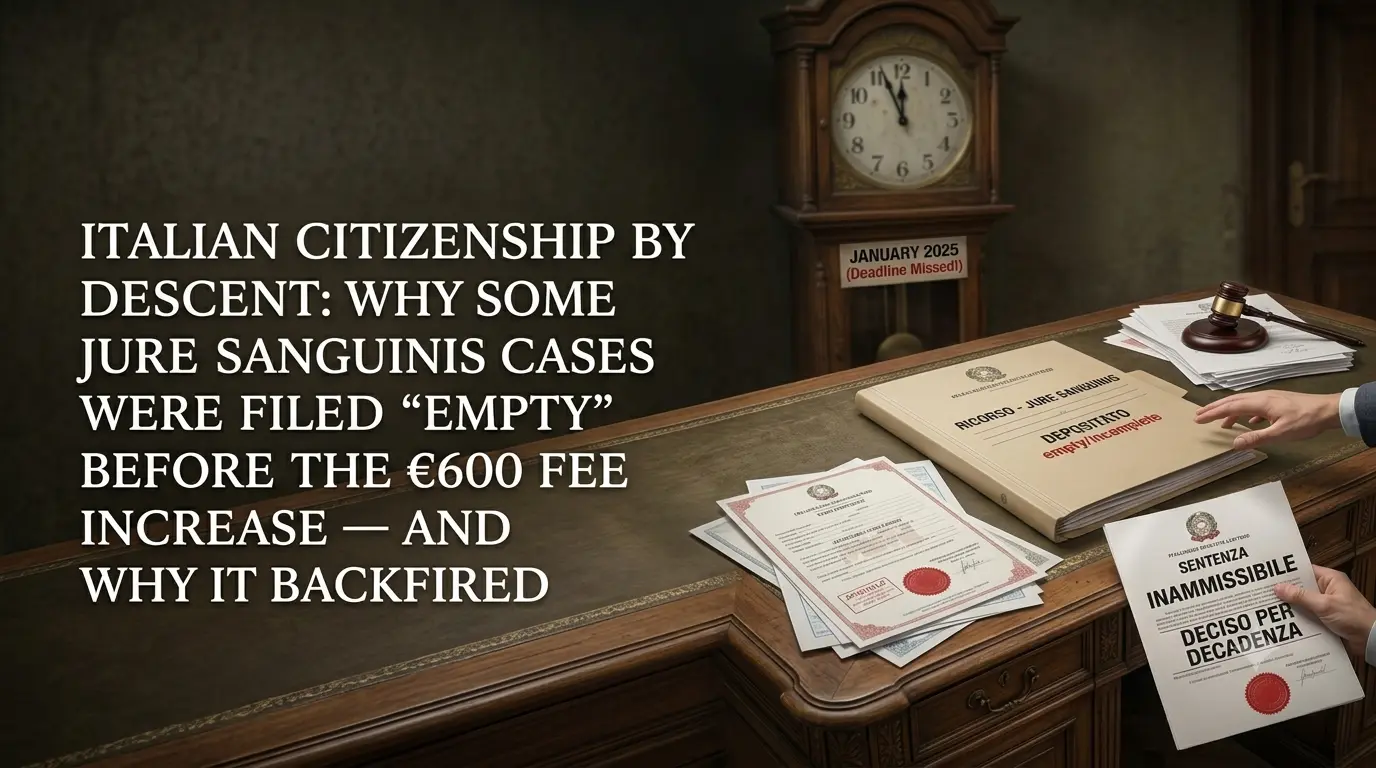
Starting in January 2025, the contributo unificato (court fee( for jure sanguinis proceedings rose to €600 per applicant — a substantial jump for multi-generational filings involving several co-applicants. In the months leading up to that increase, a number of firms advised clients to file the ricorso before year-end and produce the vital records and other supporting documents afterward, once they were ready.
The problem with “afterward”
The difficulty is that this “afterward” was rarely defined with any precision at the outset. Document collection — apostilled vital records, translations, sometimes archival research spanning multiple comuni or foreign jurisdictions — does not run on a predictable timeline. Firms advising this strategy could not realistically commit to a date by which the fascicolo would be complete, because that date depended on factors outside their control.
The result, in a number of cases, has been late deposit of the documentary evidence, followed by a sentenza rejecting the ricorso as inadmissible — not on the merits of the citizenship claim, but for failure to meet the preclusive deadlines that apply under the rito semplificato (Cartabia reform)
A case in point
A family recently came to the studio with this exact scenario: a ricorso filed with only the powers of attorney attached, vital records deposited months later (though still before the udienza), and a ruling rejecting the case for lack of proof — merits never reached, despite no opposition from the Ministry or the Prosecutor. The filing was deliberately “empty,” apparently to lock in a pre-decreto filing date. The irony is that the same choice that may now sink the case on procedural grounds is also what placed it under the more favorable pre-reform rules — meaning a fresh filing today might not even qualify.
What counts as “late”? A split that matters
The case law here is not settled, and the split maps roughly onto three different readings of the reformed rito semplificato.
The strict view. Some tribunals treat the deposit of vital records and other documentary evidence as required contestually with the iscrizione a ruolo — i.e., alongside the ricorso itself. On this reading, anything filed later is untimely in light of the Cartabia reform’s tightened preclusion architecture, regardless of whether it arrives before the first hearing.
The more permissive view. Other decisions read Art. 281-duodecies c.p.c. (as amended by D.Lgs. 164/2024) more narrowly: the provision does not impose an automatic decadenza on the ricorrente for failing to indicate evidence or produce documents in the ricorso introduttivo — unlike the express rule for the convenuto’s counterclaims and non-officiosa exceptions under Art. 281-undecies, comma 3. Under this view, the only perentorio deadline for instructional evidence is the one the judge actually sets under Art. 281-duodecies, comma 4; if the documentation is indicated and produced before the udienza di comparizione — or within whatever term the judge grants — there is no decadenza, and an objection raised by the convenuto (or, in these cases, the Ministry, when it appears) should be rejected — a reading several tribunals have adopted.
A third, more restrictive reading. A further line of authority narrows things even more. Under Art. 281-duodecies c.p.c., when the need to supplement arises from the counterparty’s defenses, the judge — if requested — grants the parties a perentorio term of no more than twenty days to amend claims, exceptions, and conclusions, to indicate evidence, and to produce documents, plus a further term of no more than ten days to reply and offer contrary proof. On this reading, any documentary integration is possible only if connected to the counterparty’s defenses — a faculty the law grants specifically to let a party respond to objections raised by the opponent, not a general window for the ricorrente to complete its own case on its own initiative. Where this reading prevails, it is the most unfavorable of the three for an empty-filed ricorso: since in most jure sanguinis cases the Ministry doesn’t appear and raises no defenses at all, there is no counterparty defense to trigger the supplementation window in the first place — meaning the ricorrente never gets the twenty-day term to begin with, regardless of when documents are actually deposited.
This is not a minor technicality. It means the outcome of an “empty-filed” ricorso can depend heavily on which tribunal — and in some cases which judge — ends up hearing it, independent of the strength of the underlying descent claim.
The practical takeaway
This is not a hypothetical risk — it is happening now. The cases filed “empty” in the run-up to the contributo unificato increase are reaching their hearings and their sentenze this year, and a number of them are coming back as rejections on exactly this ground: documents produced too late, under whichever reading of the preclusion rules the assigned tribunal happens to follow. Families who filed this way should not wait to find out; if a hearing date is approaching, or a sentenza has already arrived, the sentenza needs to be reviewed now against the three readings above, because the answer determines whether an appeal is even worth pursuing — and, for pre-decreto cases, whether it is the only route left to preserve the claim at all.