In Italian family reunification proceedings, the housing suitability certificate (attestazione di idoneità alloggiativa) is the document through which the applicant demonstrates that the accommodation they intend to use meets the health, safety, and habitability standards required by law. This is not a secondary formality: in practice, it is one of the most frequent points at which applications stall.
The problem is almost never the absence of housing. Difficulties arise when the certificate is incorrect, when the property indicated is inconsistent with the supporting documentation, when the occupancy data does not match, or when the case requires a different legal framework from the standard one.
This guide covers when the housing suitability certificate is required, who issues it, what documents are needed, what parameters are assessed, and the most common special cases.
What the housing suitability certificate is and when it is required
In standard family reunification proceedings, the applicant must demonstrate the availability of accommodation that meets the applicable health and habitability requirements. The legal basis is Article 29, paragraph 3, letter a) of the Consolidated Immigration Act (Legislative Decree No. 286/1998), while the implementing regulations govern the documentation to be attached to the nulla osta application.
From a practical standpoint, it is not sufficient to declare that housing is available: the correct documentation must be submitted, and it must be verified that the property indicated is actually compatible with the number and category of family members to be reunited.
An important clarification: the application for the housing suitability certificate may be submitted not only by the property owner, but also by the tenant or by the person who resides, is domiciled, or is hosted at the property. Availability of accommodation does not therefore require ownership.
Do you need assistance with your family reunification application?
Book a consultation
Who issues the housing suitability certificate
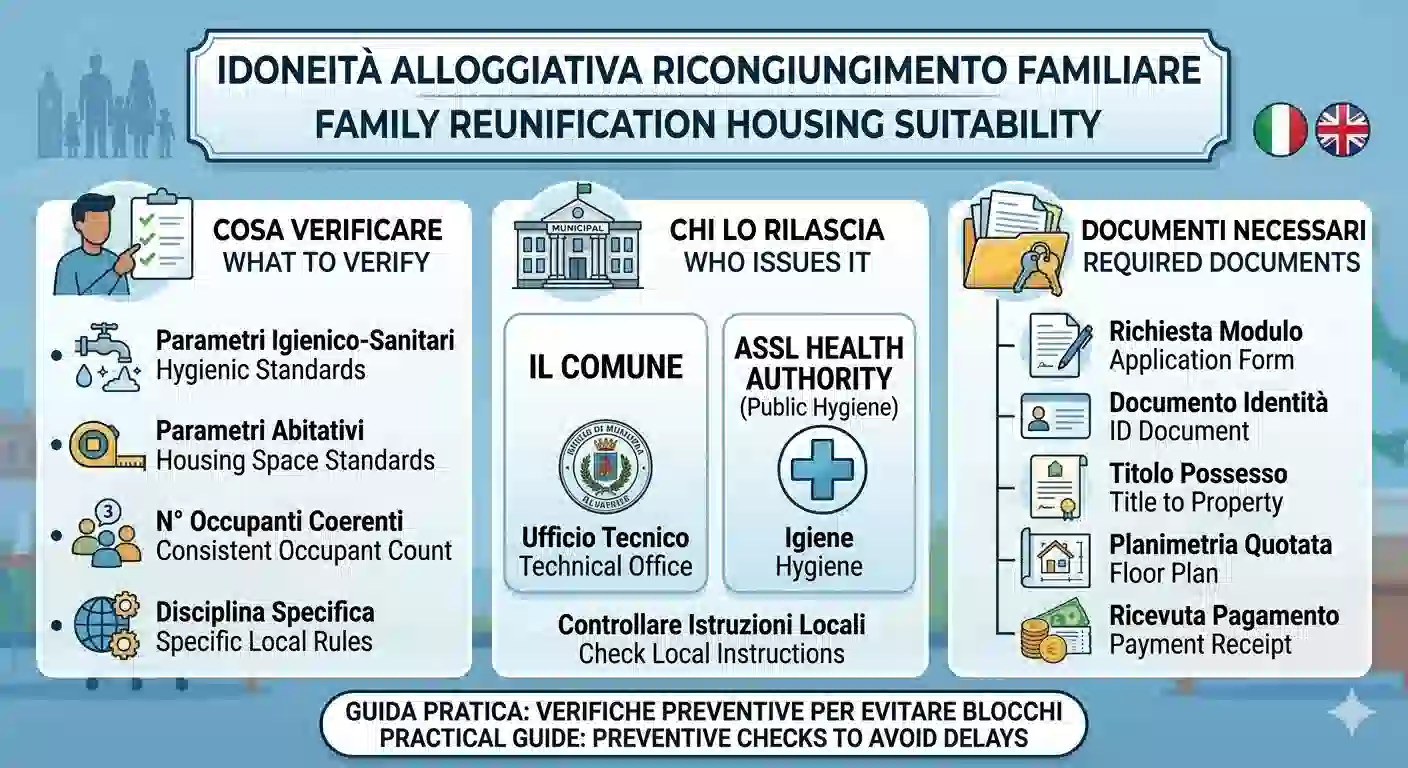
As a general rule, the certificate is issued by the municipality in whose territory the property is located. Depending on the administrative structure of the local authority, competence may lie with the Municipal Technical Office or with the Public Health Department of the local health authority (ASL).
Procedures vary from one municipality to another: forms, required documents, and processing times are not uniform across Italy. Before starting the procedure, it is therefore necessary to verify which office has competence in the municipality where the property is located and what the applicable local requirements are.
Documents required to apply for the housing suitability certificate
A generic request is not sufficient. In practice, the applicant must normally submit:
- a valid identity document
- a valid residence permit or, where applicable, an expired permit together with the receipt for renewal or conversion
- proof of availability of the property: lease agreement, loan for use (comodato), or title deed
- a hospitality declaration, if the applicant is hosted by a third party
- cadastral floor plan of the property and, where required, an indication of the intended use of each room
- municipal forms and any additional technical documentation required by local practice
- a €16 revenue stamp, where required by the applicable municipal procedure
The housing documentation must then be coordinated with the nulla osta application and all other attachments in the file. Any inconsistency between the documents submitted to the municipality and those filed with the Sportello Unico per l’Immigrazione can block the procedure even when the underlying requirement is genuinely met.
How long does it take to obtain the certificate
There is no uniform processing time applicable across all municipalities. Timelines depend on the administrative capacity of the competent office, the completeness of the documentation submitted, and whether an inspection of the property is required.
Given this variability, when family reunification is urgent it is advisable to initiate this step early, without waiting for the other stages of the procedure to be finalized.
In some cases it is possible to attach the receipt of the certificate application and submit the actual certificate once issued. This option requires careful consideration, however: not all Sportelli Unici per l’Immigrazione accept it in the same way, and local practice should be verified before proceeding on this basis.
Parameters assessed for housing suitability in family reunification
Municipalities assess housing compliance based on the health and habitability standards applicable to the specific case. The standard technical reference is Ministerial Decree of 5 July 1975, which sets out the minimum requirements for residential premises, subject to each municipality’s own organizational and procedural arrangements.
The most common checks involve:
- floor area in relation to the number of occupants
- presence and suitability of the main rooms
- ventilation and natural lighting
- overall health and sanitary compliance of the property
- consistency between the declared property, the proof of availability, and the actual occupancy situation
An important point: the certificate is not issued solely on the basis of floor area. The assessment is comprehensive and takes into account the documentation submitted, the checks carried out by the competent authority, and the consistency between what has been declared and the actual condition of the property.
Is the housing suitability certificate required when reuniting a child under 14?
Where only one child under the age of 14 is being reunited, a more favorable rule applies: the standard housing suitability certificate is not required. Instead, it is sufficient to obtain the consent of the property owner or title holder at the address where the child will actually reside.
This does not mean that housing becomes irrelevant: the availability of the accommodation must still be properly documented, and the correct forms for this specific case must be used. The difference from the standard procedure concerns the form of documentation required, not the absence of the housing requirement altogether.
Is the housing suitability certificate required for holders of international protection?
Holders of international protection benefit from a more favorable legal framework than the standard family reunification procedure. In particular, Article 29-bis of the Consolidated Immigration Act excludes the application of the requirements set out in Article 29, paragraph 3 — including the standard housing requirement.
When the applicant holds international protection status, treating the case as a standard family reunification application is therefore an error that can compromise the entire procedure. Verifying the type of protection held is the first step to take before any other action.
Does the housing suitability certificate expire?
As a general rule, the certificate is valid for six months. In family reunification proceedings, however, it may be used beyond this period provided that the housing situation remains consistent with what was certified at the time of issue.
If the certificate includes the number of residents or occupants, it is advisable to coordinate it with an updated self-declaration of household composition, so as to accurately reflect the current registry situation of the property at the time of filing.
In family reunification proceedings, the issue is not only the date on the certificate but its currency relative to the actual situation of the property. If the residents, guests, or conditions of availability have changed in the meantime, the certificate may need to be updated or supplemented with additional documentation before it is submitted.
Can the family member be reunited at a different address from where the applicant lives?
This is permitted where the family member to be reunited is the applicant’s spouse. In all other cases, the standard framework does not allow an address to be indicated that differs from the applicant’s actual place of residence. This is one of the aspects most frequently overlooked in practice and can lead to requests for supplementary documentation or outright refusals even when the file appears formally complete.
The gap between law and administrative practice
Many family reunification applications are not blocked because housing is unavailable, but because the housing suitability certificate is incomplete, out of date, or inconsistent with the other documentation in the file.
The most frequent practical issues involve:
- a certificate issued for a different property from the one indicated in the nulla osta application
- occupancy data that is outdated or inconsistent with the applicant’s household registration certificate
- proof of availability of the property that has not been correctly documented
- a change of address during the procedure without updating the documentation
- application of the standard procedure to cases that require a special legal framework
Verifying with an immigration lawyer the housing requirement carefully before submitting the application — and ensuring that the housing documentation is consistent with all other documents in the file — is one of the most effective steps to avoid unnecessary delays and to structure the procedure correctly from the outset.