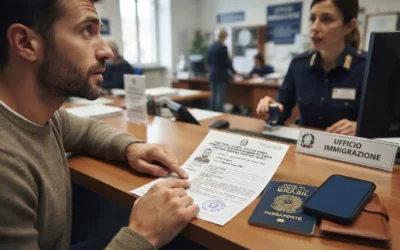
What is the EES system
If you’re wondering what is EES system, here is the short answer: the EES system is the European Union’s new automated border-control infrastructure, part of the broader Smart Borders program. It electronically registers every entry and exit of non-EU nationals at the external borders of the Schengen Area, replacing the manual passport stamp with a digital record tied to biometric data. Beyond speeding up border checks, it also gives travelers a way to verify online how many days of their authorized stay they have left.
What does EES stand for
EES stands for Entry/Exit System. The EES meaning is straightforward once you break down the acronym: the name describes exactly what it does, logging the date, time, and location of every border crossing — both entering and leaving the Schengen Area — for travelers who fall within its scope.
Who does the EES apply to
The EES system EU authorities have introduced covers third-country nationals — meaning anyone who is not a citizen of an EU country, Iceland, Liechtenstein, Norway, or Switzerland — traveling to the Schengen Area for a short stay of up to 90 days within any 180-day period. This applies whether or not the traveler is subject to a visa requirement.
Not sure whether you need a visa to enter Italy in the first place? See our article, Do You Need a Visa for Italy? Schengen Rules, Exemptions & the 90/180 Day Rule.
Who is exempt from the EES
The system does not apply to:
- EU, Swiss, and EEA citizens, and their family members
- Third-country nationals who already hold a valid residence permit or residence card for a Schengen state
What data does the EES collect
Each traveler’s EES record includes:
- Surname, first name, date of birth, nationality, and gender
- Passport number, issuing country, and expiry date
- A facial image
- Fingerprints of four fingers (thumbs excluded) — not required for children under 12
- Any record of a refused entry
Which biometric identifiers does the EES use
The identifiers collected depend on the traveler’s visa status:
- Travelers who need a visa: only a facial image is captured at the EES stage, since their fingerprints were already collected earlier through the Visa Information System (VIS) when the visa was issued.
- Visa-exempt travelers: the EES records both a facial image and four fingerprints at the border.
How EES registration works at the border
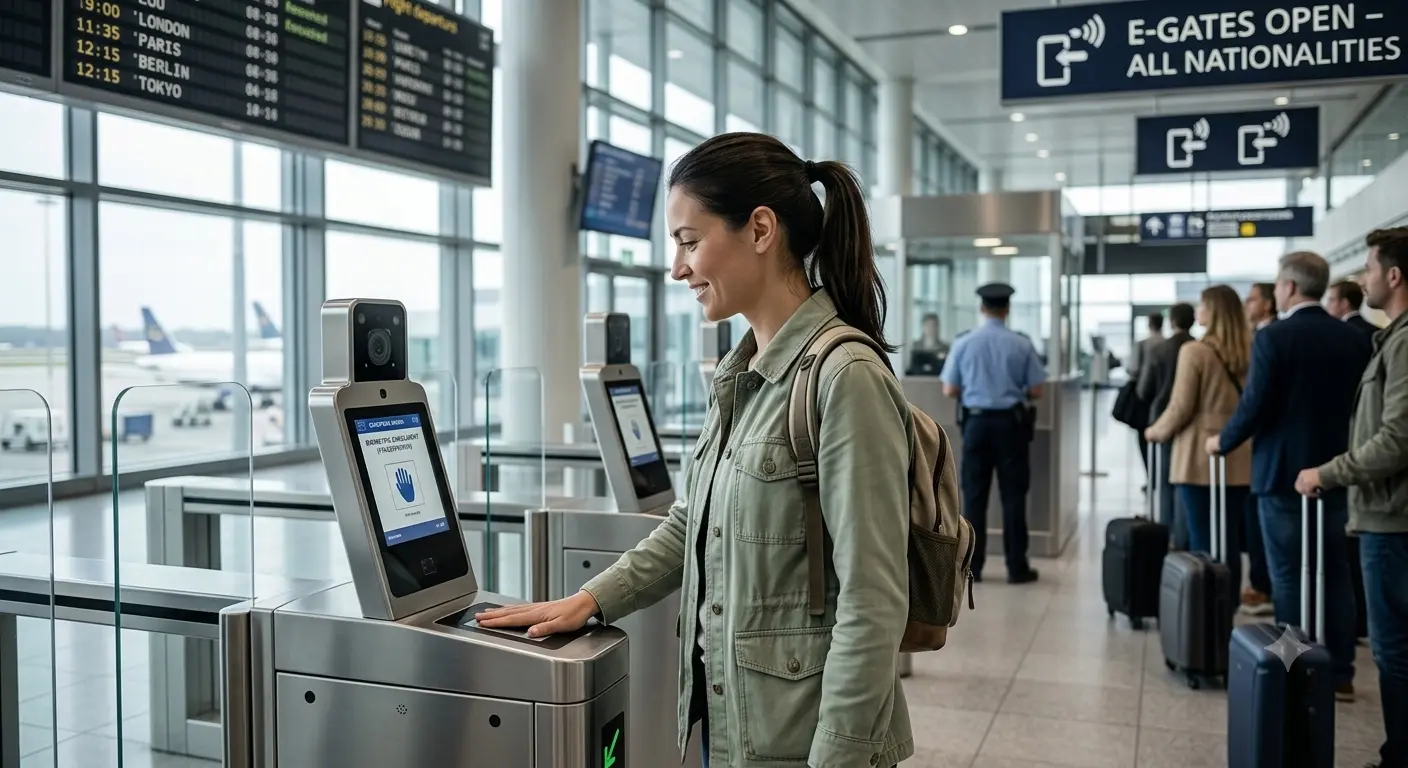
- Travelers holding a biometric passport can use a self-service kiosk to scan their own data, provided their passport is machine-readable.
- The kiosk captures biometric data (facial image and fingerprints) along with passport details and information on the entry or exit point.
- Travelers then proceed to the staffed border-control desk, where the registered data is verified. If there is no reason for refusal, the officer authorizes entry or exit, and this decision is also logged in the EES.
Travelers without a biometric passport must go directly to a staffed border-control desk instead of using the self-service kiosks.
Unlike a visa or ETIAS authorization, the EES application is not something travelers complete in advance — registration happens automatically at the border itself, the first time a traveler crosses under the new system.
Entry and exit at Schengen airports
For travelers with connecting flights, entry is always recorded at the first Schengen airport reached, even if a domestic European flight follows. Exit is recorded at the last Schengen airport before leaving the area.
Which European countries use the EES
Understanding what is EES Europe-wide starts with the list of participating states. The EES Europe rollout currently covers: Austria, Belgium, Bulgaria, Croatia, Czech Republic, Denmark, Estonia, Finland, France, Germany, Greece, Hungary, Iceland, Italy, Latvia, Liechtenstein, Lithuania, Luxembourg, Malta, Netherlands, Norway, Poland, Portugal, Romania, Slovakia, Slovenia, Spain, Sweden, and Switzerland.
Cyprus and Ireland do not currently participate in the EES; manual passport stamping still applies there.
Is the EES the same as ETIAS
No — these are two different systems working at two different moments of the journey:
- The EES records entries and exits at the moment travelers physically cross the border.
- ETIAS (European Travel Information and Authorisation System) is a pre-travel electronic authorization, similar to the US ESTA, that citizens of visa-exempt non-EU countries (such as the United States, Canada, Australia, and Japan) will need to obtain online before departure.
When will EES be implemented and ETIAS follow
The EES has been rolling out gradually since 2025 across Schengen border points. ETIAS is expected to become operational in the last quarter of 2026; once active, visa-exempt travelers will need both an ETIAS authorization obtained in advance and EES registration at the physical border. For the full EES ETIAS timeline implementation, national authorities continue to phase in checks border by border rather than switching on the system EU-wide at once.
Is the EES causing delays at Italian airports right now
Yes — and it has become a major story in the Italian and European press this summer. The EES became fully operational on April 10, 2026, requiring non-EU arrivals to register facial images and fingerprints, and it has caused queues and delays from the start. Airport and airline trade associations (A4E, ACI Europe, and IATA) have written an open letter to the European Commission warning that border wait times have reached up to five hours at peak times.
Aeroporti di Roma, which operates Fiumicino and Ciampino, has publicly warned that the system risks disrupting regular air traffic during the busiest summer months, and is requesting more flexibility in how checks are applied. Frontex has estimated the situation should stabilize within one to two years, since first-time biometric enrollment is the most demanding part of the rollout.
What this means for travelers: expect longer processing times at Italian airports, especially through August 2026, and build in extra time — some travel advisories recommend arriving at the airport up to three hours before international flights.
EES travel: how to prepare
- Make sure your travel documents are in order, including a valid biometric passport where applicable.
- Check the specific entry requirements in force for your destination before departure.
- If you hold a Swiss, EU, or EEA passport, or a valid Italian residence permit, you can generally use the eGates.
- If you hold a long-stay visa, go directly to a staffed border desk rather than a self-service kiosk.