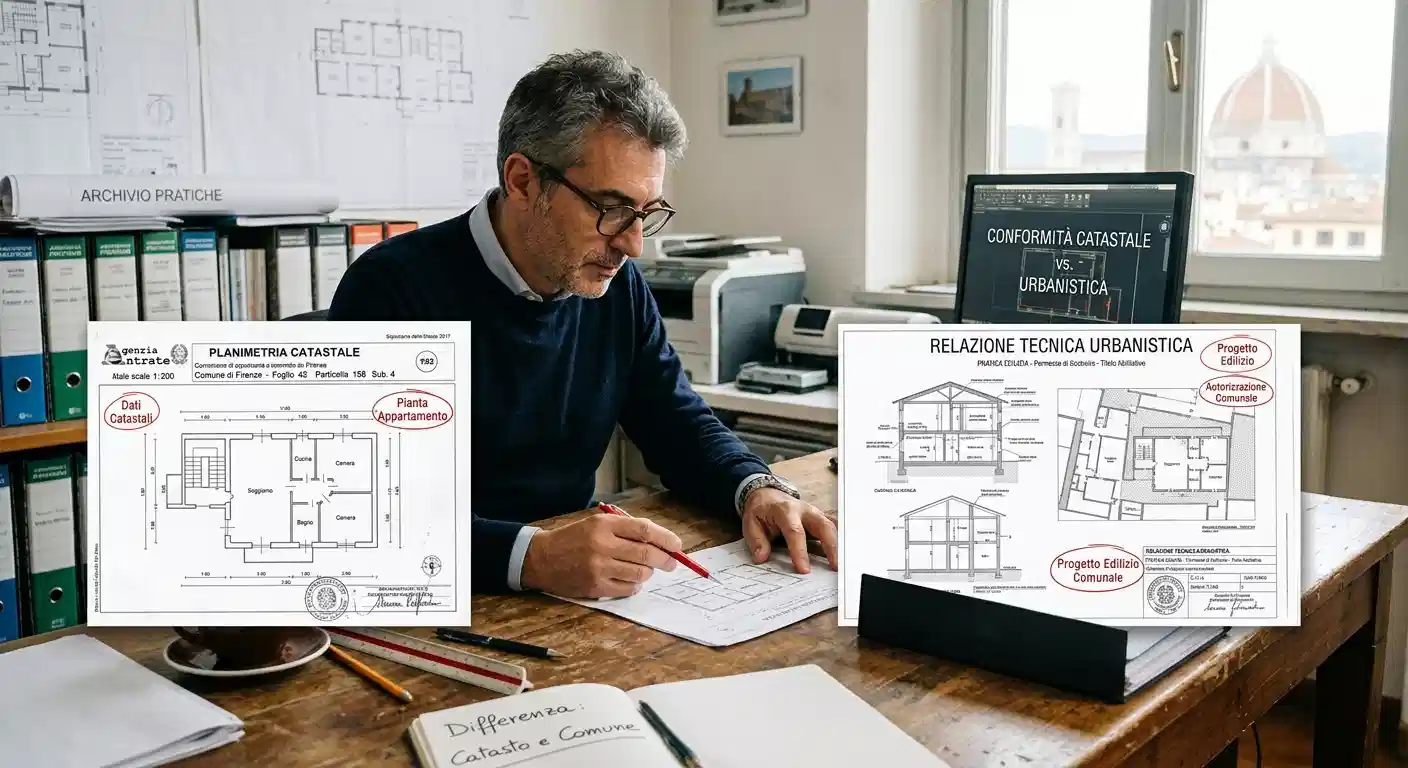
When buying property in Italy, especially if you’re a foreigner unfamiliar with how the Italian system works, it’s easy to assume that one check is enough: making sure the cadastral floor plan matches the apartment you’re buying.
If the rooms are where they should be, the windows line up, and the internal layout matches what’s shown on the floor plan, why would there be a problem?
Because cadastral compliance and urban planning compliance are two different things.
They are verified against different documents, concern different aspects of a property’s legal status, and can produce very different consequences. A perfectly up-to-date cadastral floor plan can accurately represent a home’s current state without proving, on its own, that state was ever authorized under the relevant building permits.
For anyone buying property in Italy, this isn’t a purely technical distinction. It can become one of the most consequential pitfalls of buying property in Italy: a very concrete issue when deciding whether to submit an offer, sign a preliminary contract, apply for a mortgage, or, a few years later, resell the property.
What is cadastral compliance?
Cadastral compliance concerns the correspondence between the data and floor plan filed with the Land Registry (Catasto) and the property’s actual, physical state.
The Catasto is managed by the Italian Revenue Agency (Agenzia delle Entrate) and serves primarily a tax and property-representation function. This doesn’t mean cadastral compliance is legally irrelevant — quite the opposite. The law imposes specific cadastral requirements on property transfer deeds, and the declaration required under Article 29, paragraph 1-bis of Law 52/1985 is essential for the validity of the notarial deed in the cases provided by law.
The key point, however, is different: cadastral compliance does not certify that a property is legitimate from a building-law standpoint.
A floor plan can therefore be perfectly up to date and match exactly what you find inside the apartment, without this proving that every change it represents was actually authorized by the municipality.
What is urban planning compliance, then?
Urban planning compliance in Italy (concerns the relationship between a property’s current state and the building permits that authorized its construction and any subsequent modifications.
Depending on the era and the type of work, the relevant documentation may include a building license (licenza edilizia), a building concession (concessione edilizia), a building permit (permesso di costruire), or other permits and filings such as a CILA or SCIA.
Verifying this therefore requires looking at the planning documentation held by the municipality (Comune) and, when necessary, reconstructing the property’s history: what was originally authorized, what changes were made later, and whether those changes were themselves authorized, subsequently regularized, or might fall under one of the cases provided for by current regulations.
This is a very different check from the cadastral one.
A concrete example: an 8-square-meter bedroom
Imagine an apartment where, over the years, an 8-square-meter single bedroom was created. The change is then correctly reflected in the cadastral floor plan.
Today, anyone looking at the floor plan finds exactly what they find walking into the apartment. There’s no discrepancy between the cadastral document and the physical reality.
But the planning question is different: was that room built in compliance with the applicable building regulations?
If, for that specific situation, a minimum size requirement applied and the applicable minimum surface area was 9 square meters, the fact that the 8-square-meter room was correctly reported to the Catasto wouldn’t automatically mean the change was legitimate from a planning standpoint.
The Catasto can accurately represent what exists without certifying that what exists was built in compliance with building regulations.
This is precisely the point that often gets overlooked.
A correct cadastral floor plan doesn’t necessarily mean a property is compliant with urban planning law.
Technical note: It’s worth noting that the Catasto applies its own internal size thresholds too (a locally defined “minimum room size” that varies by municipality and cadastral category), used purely to classify a room as a “main room” or an “accessory” for the purpose of calculating the property’s cadastral income (rendita). Falling below that threshold doesn’t block the filing — it simply changes how the room is classified for tax purposes. This is entirely different from, and unrelated to, the minimum habitable surface required under hygiene and health regulations (Ministerial Decree of July 5, 1975), which is what determines whether a room can legally be used as a bedroom. The Catasto verifies only the former; it has no bearing on the latte
A non-conformity doesn’t necessarily mean the entire property is illegal
When people hear “planning irregularity,” they tend to picture a house built entirely without authorization. In practice, though, the situation is often far more nuanced.
A non-conformity can involve an internal modification, a different room layout, an opening, a differently configured section of the property, or a more significant intervention that altered surface area, volume, or intended use.
Some of these situations can be regularized; others may fall within the tolerances set out by current regulations; others still may require restoration work, or present problems that can’t simply be resolved through a building permit application.
For this reason, it isn’t correct to conclude, without further checks, that a house is simply “compliant” or “illegal.”
First, you need to understand what was built, when it was built, what permit was required, and what regulations apply today to that specific situation.
This distinction matters particularly in Italy, where many properties have a building history going back several decades and have been modified under the responsibility of different owners over time.
A house can have a building history far longer than its current owner’s
A property built in the 1970s might have been modified in the 1980s, renovated again in the 1990s, and then purchased by its current owner in 2010.
It’s therefore not at all unusual for a non-conformity to predate the current owner.
This also helps clarify a common misunderstanding: the fact that the seller didn’t personally carry out the modification doesn’t mean the issue is irrelevant to the buyer.
From the standpoint of personal responsibility and reconstructing what happened, knowing who carried out the work can matter. But before buying, the buyer above all needs to know the current legal and technical status of the property they’re purchasing.
This is why a proper due diligence process shouldn’t stop at asking the seller, “Are there any problems with the property?”
The documentation needs to be checked.
The fact that a house has already been sold before is not a guarantee
Another fairly common assumption is that, if a property has already changed hands several times, any irregularities would surely have already been identified.
That’s not the case.
The fact that a property has been transferred before doesn’t mean it has ever undergone a full urban-planning due diligence review. A non-conformity may never have been identified, may have been dismissed as irrelevant without a thorough analysis, or may simply have been created afterward.
A previous sale, in other words, is not a substitute for the verification that should be carried out in the interest of the new buyer.
This holds true even when the seller states, in complete good faith, that “everything is in order.” The seller may simply be relying on whatever documentation was handed to them when they purchased the property themselves.
What about the notary? Don’t they check that the house is compliant?
This is one of the questions I get most often from foreign buyers.
The notary plays an essential role in a real estate transaction and verifies the legal and documentary aspects the law assigns to them. But notarial review shouldn’t be confused with a full urban-planning due diligence carried out in the buyer’s interest.
In particular, urban planning compliance is not automatically established by the notary through a technical reconstruction of the property’s legitimate status at the municipal offices.
The property’s planning status is normally the subject of declarations made by the seller in the deed, and where an in-depth technical review is needed, it must be carried out by a licensed professional — a surveyor (geometra), architect, or engineer.
The Italian Higher Vourt (Corte di Cassazione), in ruling No. 10914/2025, addressed precisely this issue — the limits of a notary’s role with respect to verifying a property’s legitimate status and its building permits.
This doesn’t mean the notary is irrelevant to verifying the property. It means, rather, that the buyer shouldn’t wait until closing (the rogito) to find out whether the house they’re buying actually matches the planning documentation.
The right moment to ask that question is much earlier.
Need help verifying a property’s urban planning compliance before you buy? Book a consultation
Due diligence should happen before the offer
From the buyer’s perspective, the best time to carry out this review is before taking on any contractual commitment.
Ideally, due diligence should therefore come before the purchase offer.
In practice, however, the market doesn’t always allow for that kind of timeline.
There may be a particularly appealing property, there may be multiple interested buyers, and the seller may want to receive an offer quickly. In some cases, the real estate agent may mention that other prospective buyers are already interested.
At that point, the buyer faces a very concrete dilemma: wait to complete every check and risk losing the property, or make an offer before due diligence is complete.
There’s no single right answer for every situation.
What shouldn’t happen is for the buyer to sign simply out of fear of losing the house, without understanding what risks they’re taking on.
When a full review can’t be completed before the offer, it becomes even more important to think carefully about how the contractual commitment is structured, and what conditions need to be included to protect the buyer.
When the review isn’t complete yet, the contract becomes especially important
An offer or a preliminary contract shouldn’t be treated as mere formalities.
If the technical due diligence hasn’t been completed yet, the contract can, depending on the circumstances, include specific protections governing what happens if the review later reveals non-conformities.
The exact wording will naturally depend on the specific case. It may be necessary to establish who must provide certain documents, who bears the cost of any regularization, within what timeframe a non-conformity must be resolved, and what happens if the problem can’t be fixed at all.
This matters because a generic clause simply stating that “the property is compliant” isn’t necessarily enough to protect a buyer from a situation that was never actually verified.
On the other hand, when due diligence has already been completed and the property’s situation has been clarified, filling the contract with standard boilerplate clauses that add no real protection isn’t necessarily useful either.
Contractual protection should be built around the risk actually identified, not simply added as a routine formula.
The Salva Casa Decree: what changed?
The regulatory framework became even more layered with the so-called Salva Casa Decree, introduced by Decree-Law 69/2024 and converted into Law 105/2024, AKA as “Decreto Salva Casa”
The law introduced significant changes regarding construction and execution tolerances and the regularization of certain non-conformities, setting, among other things, size-based thresholds for tolerances applicable to work carried out by May 24, 2024.
These provisions are particularly relevant to property due diligence, but they need to be applied carefully.
The Salva Casa Decree is not a blanket amnesty, and it doesn’t mean that any unauthorized work can now automatically be regularized.
Whether a given procedure is available depends on the nature of the non-conformity, when it occurred, the original permit, the characteristics of the work carried out, and the regulations that apply to it.
In other words, finding a discrepancy between a property’s current state and an old approved plan doesn’t, by itself, allow you to conclude either that the property is hopelessly illegal or that the non-conformity can easily be fixed.
The specific case needs to be assessed on its own terms.
Why the date of the non-conformity can matter
When an irregularity is identified, one of the first questions to ask is when it occurred.
A modification dating back to the building’s original construction has a different history than work carried out by the current owner just a few years ago.
For older situations, previous building amnesties may come into play, including those from 1985, 1994, and 2003 — always within the limits and conditions set by their respective laws.
For more recent work, today’s applicable regulations may be relevant instead, including those introduced by the Salva Casa Decree.
The date, then, isn’t just a historical detail. It can be one of the factors determining which legal tools are actually available.
The risk many buyers consider too late: reselling
One of the reasons I recommend addressing these checks before purchase is that a planning issue may not become apparent right away.
A buyer may purchase the home, live in it for years, and never face a single challenge.
The problem may only surface when they decide to sell.
At that point, the new buyer may hire a technical professional to carry out due diligence, and that review may uncover a non-conformity that was never previously identified.
Depending on the nature of the problem, it may be necessary to pursue regularization, incur costs, obtain additional documentation, or — in cases where regularization isn’t possible — consider other courses of action.
Where certain restrictions apply, or where the non-conformity is particularly serious, the consequences can be significantly more severe.
This is why, when I assess a property purchase for a client, I don’t only ask, “Can we buy this property?”
I also ask a question that’s often raised too late:
“Will this property be easy to sell in the future?”
Don’t confuse a non-compliant house with a house you can’t buy
This is another important point.
Discovering a non-conformity doesn’t necessarily mean the only option is to walk away from the purchase.
In some cases, the situation can be regularized. In others, it may be necessary to adjust the price or ask the seller to take action before closing. In others still, it may be possible to proceed — but only after fully understanding the nature of the non-conformity and its consequences.
The right decision depends on the specific problem.
The real mistake is making a decision before knowing what the problem actually is.
Who is responsible for checking what?
An Italian real estate transaction involves several different professionals, but their roles aren’t interchangeable.
The technical professional verifies the property’s technical, planning, and cadastral aspects. The notary handles the aspects of the closing itself and the checks the law assigns to them. The real estate agent operates within the scope of the brokerage relationship and the information duties tied to the sale. The lawyer, when involved in due diligence, can instead analyze the legal consequences of the technical findings, assess contractual risk, and help the buyer translate those findings into concrete conditions for the purchase.
It’s precisely the coordination between these different levels that can make the difference.
A technical report, on its own, can tell you that a non-conformity exists.
The next question is understanding what that non-conformity means for the contract you’re about to sign.
And that’s a legal question, not just a technical one.
Real due diligence isn’t just about checking a floor plan
When a foreign client asks me whether a property is “compliant,” the question shouldn’t be answered simply by comparing a floor plan to the rooms of the apartment.
You need to reconstruct the property’s history and cross-reference different documents: what was authorized, what was built, what was later modified, and what is currently on file with the Catasto.
Only then is it possible to determine whether a non-conformity exists, what its nature is, and what consequences it may carry.
For this reason, real estate due diligence in Italy shouldn’t be seen as an extra cost incurred just to “check the paperwork.”
It’s a tool for knowing exactly what property you’re buying before taking on a commitment that could last for years.
And above all, for a foreign buyer, it means not relying on the simple impression that “everything looks fine.”
Because a house can appear to be in perfect order, have an up-to-date cadastral floor plan, and have already been sold multiple times.
The question that really matters is a different one:
“does what I’m buying actually match what was authorized — and what will happen the day it’s my turn to sell it?”