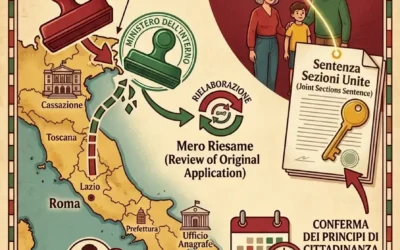

The July 2026 Sezioni Unite rulings resolved one specific legal question — but not every family history fits it. Below are nine common scenarios, built around the legal distinctions actually established by the Cassazione, to help you understand where your case likely stands.
The 5 dates you need to know
Before looking at individual scenarios, a few dates set the boundaries for the whole analysis:
March 10, 1975 — entry into force of Legge n. 39/1975, which lowered the age of majority from 21 to 18. This is the dividing line for working out which age threshold applies to your case.
October 3, 2024 — the Ministero dell’Interno issued Circolare n. 43347/2024, instructing consulates to treat a parent’s naturalization as an automatic cause of citizenship loss for a minor child. This circular has not yet been formally withdrawn.
March 27, 2025, 11:59 PM (Rome time) — the cutoff date under Article 3-bis of Legge 74/2025: judicial claims filed before this date remain governed by the previous legal framework.
July 23, 2026 — the Constitutional Court issued Ordinanza n. 147/2026, referring questions about the two-generation limit (Legge 74/2025) and its compatibility with EU law to the Court of Justice of the European Union.
July 26, 2026 — the Corte di Cassazione Sezioni Unite published Sentenza n. 24045/2026 (followed days later by n. 24184/2026), resolving the Minor Issue at the judicial level.
August 10, 2026 — the Ministero dell’Interno issued Circolare n. 65050/2026, formally superseding the 2024 circular and instructing consulates and comuni to apply the Sezioni Unite’s ruling, including a review path for previously rejected applications.
Scenario 1: Dual citizen at birth, parent naturalized while the child was a minor
Your ancestor was born abroad in a country applying ius soli (e.g. the US, Brazil, Argentina, Canada, Australia) to an Italian parent, and so held both citizenships from birth. The Italian parent later completed naturalization abroad while that child was still underage.
Outcome: favorable. This is exactly the scenario resolved by Sentenze nn. 24045/2026 and 24184/2026. Under Article 7 of Law 555/1912, the child kept Italian citizenship, and the line of transmission remains intact.
Scenario 2: Dual citizen at birth, parent naturalized after the child turned 18 (or 21)
Same starting point as Scenario 1, but the parent’s naturalization was completed only after the child had already reached the age of majority.
Outcome: the Minor Issue does not arise — the line of transmission was never broken. The relevant age threshold is 18 for naturalizations finalized on or after March 10, 1975, and 21 for those finalized earlier. If the child was already an adult, Article 12 never had any application in the first place, regardless of the Minor Issue.
Scenario 3: Dual citizen at birth, parent’s naturalization never completed
Same as Scenario 1, but the naturalization process the parent went through was never actually finalized — for example, an initial application or declaration of intent was filed, but the final formal act was never taken, or was taken decades later once the child was already an adult.
Outcome: likely no loss ever occurred. Naturalization is treated as complete only upon the final act (e.g., the Oath of Allegiance in the US system), not an earlier filing. If that final act never happened while the child was a minor, there may be nothing to “recover” — worth confirming with the exact records before assuming this is a Minor Issue case.
Scenario 4: Exclusively Italian at birth, lost citizenship as a minor due to a parent’s naturalization
Your ancestor was born in Italy — or in a country without ius soli — and held only Italian citizenship. Their own parent later naturalized abroad while they were still a minor, and under the applicable rule (Article 12, paragraph 2), citizenship followed the parent’s.
Outcome: currently unresolved and unfavorable. This is a different legal question from the one just decided. The July 2026 rulings confirm — rather than disturb — that this kind of loss remains valid. A further Cassazione hearing, scheduled for December 17, 2026, may address this scenario specifically.
Scenario 5: Same as Scenario 4, but with a later reacquisition at adulthood
Same as Scenario 4, but the ancestor made a formal declaration to reacquire Italian citizenship upon turning eighteen, as permitted under Articles 3 and 9 of Law 555/1912.
Outcome: potentially favorable, depending on documentation. If that declaration can be documented, Italian citizenship was regained in the ancestor’s own right, and transmission to descendants would generally continue from that point forward.
Scenario 6: Line already the subject of a final judgment
Your family’s citizenship claim was previously decided by an Italian court, and that judgment is now final (passata in giudicato) — whether the outcome was favorable or unfavorable.
Outcome: the final judgment cannot ordinarily be reopened simply because the case law has subsequently changed. A final judgment definitively closes the matter between the parties; a later, more favorable precedent does not allow a concluded case to be reopened.
Scenario 7: Application still pending at an Italian consulate
Your case fits the favorable pattern in Scenario 1, but you haven’t received a response yet — your application is sitting with a consulate or comune.
Outcome: the consulate should apply the favorable rule directly. Circolare n. 65050/2026 formally instructs consulates and comuni to follow the Sezioni Unite’s ruling. A rejection on Minor Issue grounds should no longer occur for a case fitting this pattern — though if one does, filing in court remains available and benefits fully from the precedent.
Scenario 8: Application already rejected by the consulate
The consulate issued a formal denial (a preavviso di rigetto followed by a final rejection, or a direct rejection) specifically citing the parent’s naturalization during minority — under the pattern described in Scenario 1 (your ancestor was a dual citizen at birth).
Outcome: you can request an administrative review — you likely don’t need to start over. If your rejection was based solely on the now-superseded interpretation from Ordinanza n. 17161/2023 (as instructed by the old 2024 circular), Circolare 10 August n. 65050/2026 allows you to request a mero riesame — a review of your original application — from the same authority that issued the denial, rather than filing a new application. The review applies the rules in force when you originally applied, so if that was before March 27, 2025, the 2025 reform’s stricter limits won’t apply to the new decision. If your rejection rested on other grounds, or your case doesn’t fit this narrow administrative path, filing in court remains available, and can also raise any formal defects in the original rejection as further grounds supporting the case.
Scenario 9: Application not yet filed, which would fall after March 27, 2025
Your case fits the favorable pattern in Scenario 1, but you haven’t filed anything yet — administratively or judicially.
Outcome: favorable on the Minor Issue itself, but subject to the separate limits of the L 74/2025 reform– Tajani decree.
The two-generation cap introduced by Legge 74/2025 applies in full to any new filing made on or after March 27, 2025, regardless of how the Minor Issue is resolved. That limit is currently the subject of a separate referral to the Court of Justice of the European Union and remains in force in the meantime.
None of these scenarios replaces a review of your specific documentation — exact dates of birth, naturalization, and any prior filings determine which category actually applies to your family.