The nulla osta for family reunification is the administrative clearance issued by the Sportello Unico per l’Immigrazione (Single Immigration Desk) confirming that, based on the application submitted and the supporting documents, there are no legal obstacles to the entry of the family member into Italy.
In practice, this stage is central because it links the verification of the applicant’s requirements to the subsequent consular phase for the visa. The most common difficulties concern the status of the application, requests for additional documentation, pre-rejection notices, processing times, and the validity of the nulla osta once issued.
This guide covers how to submit the application, how to check the status of the procedure online, what happens in the event of a pre-rejection notice or refusal, and the key deadlines to be aware of.
Before filing, make sure all eligibility requirements are met — family reunification requirements in Italy.
What is the nulla osta for family reunification
The nulla osta for family reunification is the clearance document issued by the Sportello Unico per l’Immigrazione that enables the foreign family member to apply for an entry visa at the competent Italian consular authority in their country of residence.
It should not be confused with the visa or with the final residence permit: the nulla osta is the administrative step that precedes both. Without it, the consular phase cannot begin.
How to submit the nulla osta application
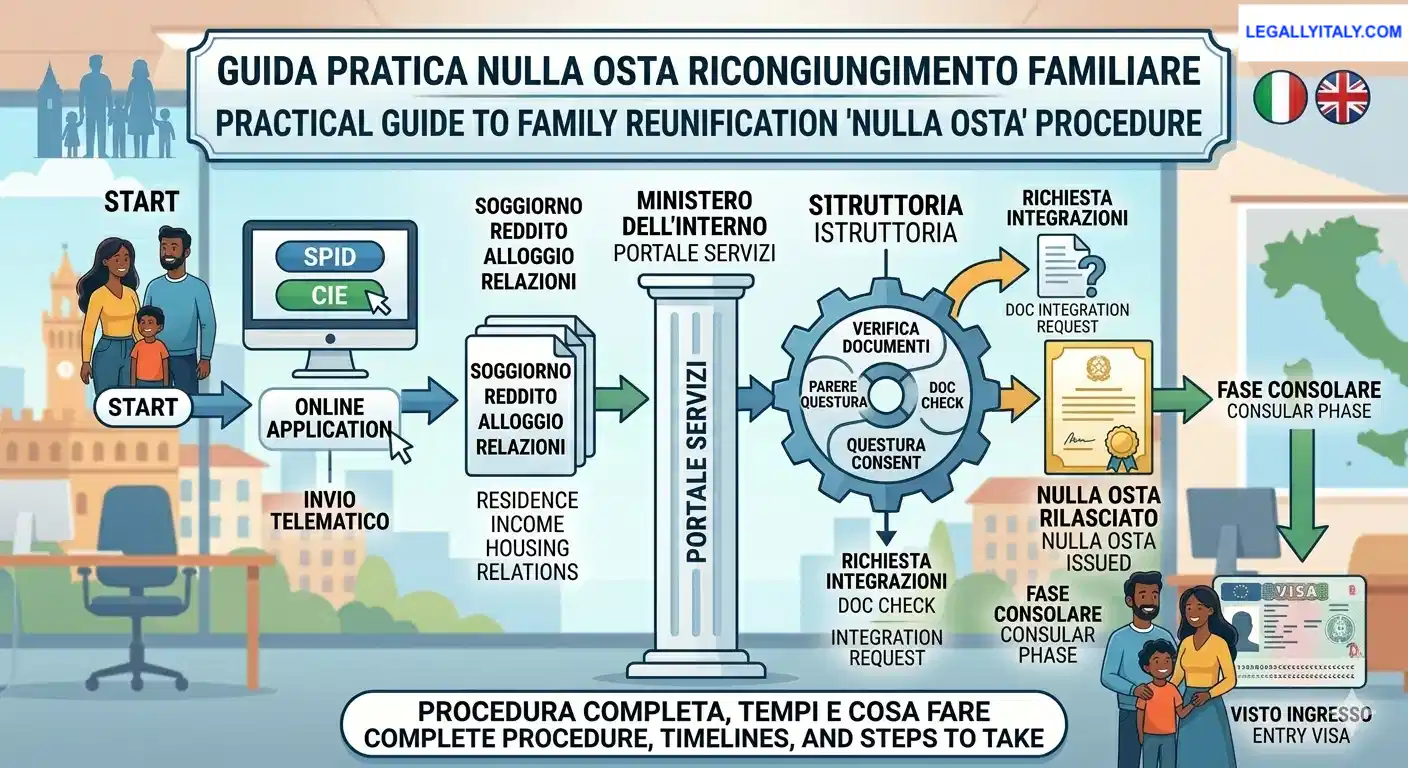
The nulla osta application must be submitted exclusively online through the Ministry of the Interior’s Services Portal, using SPID or CIE digital identity credentials. Paper applications are no longer accepted.
The application must be addressed to the Sportello Unico per l’Immigrazione at the Prefecture (Prefettura) with jurisdiction over the applicant’s place of residence or habitual abode in Italy. The required supporting documents — covering the residence permit, income, housing, and the family relationship — must be attached in digital format.
For the housing documentation specifically, see our guide on the housing suitability certificate for family reunification in Italy.”
The completeness and consistency of the documentation attached at this stage is critical: an incomplete file risks triggering requests for supplementary documents that extend processing times or, in more serious cases, a pre-rejection notice.
What happens after submitting the application
Once the application has been filed, the Sportello Unico per l’Immigrazione begins its review: it checks the supporting documents, obtains an opinion from the Questura (police headquarters) regarding any grounds that could prevent the family member’s entry, and may request additional documentation if the file is incomplete.
During this phase, the applicant can log into their reserved area on the portal to monitor the progress of the application and check for any communications or requests from the reviewing office.
How to check the status of the nulla osta online
After submitting the application, it is possible to monitor the status of the nulla osta directly online by accessing the reserved area of the Ministry of the Interior’s Services Portal. Checking the status online allows the applicant to track the progress of the review, identify any requests for additional documents, and confirm when the nulla osta is available.
The main status updates visible in the reserved area are the following:
- Pending assessment: the application has been submitted but the review has not yet begun
- Request for additional documents: the Sportello Unico has identified missing elements and is requesting supplementary documentation
- Nulla osta ready: the application has been approved and the clearance document is available for download
Important: where additional documents are requested, all required documentation must be uploaded in the designated section of the portal, merged into a single PDF file.
Nulla osta approved: how to download it
Once the nulla osta has been issued, the applicant can download the document directly from the portal and follow the operational instructions provided by the competent Prefecture for the subsequent steps.
The clearance document is also transmitted electronically to the competent Italian diplomatic or consular representation in the country where the family member resides, enabling them to begin the visa application process.
What happens if the nulla osta application is not approved
The pre-rejection notice (preavviso di rigetto)
If the Sportello Unico considers that the application cannot be approved, it may send the applicant a pre-rejection notice pursuant to Article 10-bis of Law No. 241/1990, setting out the grounds for refusal identified during the review.
Within the deadline assigned, the applicant may submit written observations and supplementary documents to clarify their position, correct any errors, produce missing documentation, or challenge the grounds cited by the office.
This stage is decisive: it often represents the last opportunity to prevent a formal rejection, and the quality of the response to the pre-rejection notice can determine the final outcome of the application.
Formal rejection and appeal
If, despite the observations submitted, the Sportello Unico issues a formal rejection decision, it is necessary to examine the grounds for refusal and assess whether there are sufficient grounds to file an appeal before the ordinary court — specifically the section specializing in immigration matters. The timing and procedural requirements for an appeal depend on the specific circumstances of the case and the reasons given for the refusal. In such cases, seeking advice from an experienced immigration lawyer at the earliest opportunity is strongly recommended.
What happens when the application is approved
If the application is approved, the Sportello Unico per l’Immigrazione summons the applicant for a final verification of the original documents where required, and notifies them that the nulla osta has been issued.
The issuance of the nulla osta does not conclude the entry procedure: the clearance document is used in the subsequent consular phase, in which the family member applies for the visa and the consular authority carries out its own verification. The nulla osta is transmitted electronically to the competent Italian diplomatic or consular representation.
Validity of the nulla osta
The nulla osta for family reunification is valid for six months from the date of issue. Within this period, the family member must apply for the entry visa at the competent Italian consular authority. If the deadline passes without a visa application being made, the nulla osta lapses and a new application must be filed from the beginning.
Processing times for the nulla osta
Article 29, paragraph 8, of the Consolidated Immigration Act provides that the nulla osta must be issued within 150 days of the submission of the application. In practice, however, actual processing times may be longer where requests for additional documents are made, supplementary checks are required, documentation issues arise, or due to the workload of the competent office.
What to do if the nulla osta does not arrive
If 150 days have passed since submission and the application is still pending, the first step is to check the exact status of the application on the portal, verify whether there are any outstanding requests for additional documents, and reconstruct a complete record of all documentation already submitted.
If the delay cannot be attributed to any genuine procedural request, it may be necessary to send a formal notice (diffida) to the competent Sportello Unico per l’Immigrazione, demanding that the procedure be concluded within a reasonable period.
If the nulla osta is still not issued after the formal notice, it may be necessary to consider judicial proceedings to protect the right to family unity and obtain a decision on the application.
The entry visa after the nulla osta
Once the nulla osta has been issued, the family member may apply for the family reunification entry visa at the Italian Embassy or Consulate with jurisdiction over their country of residence, submitting the required documentation: passport, nulla osta, certificate proving the family relationship, and any required health insurance. Some diplomatic representations use external agencies to receive visa applications.
The visa is issued or refused within 30 days of the consular application being submitted.
What the family member must do after entering Italy
Once the family member has entered Italy on a family reunification visa, they must take action within 8 days of arrival to begin the next stage of the procedure before the Sportello Unico per l’Immigrazione and the competent Prefecture.
If the Ministry’s portal allows booking, the first step is to register the first entry. If no appointments are available within 8 days or the system does not allow booking, a PEC (certified electronic mail) must be sent to the Sportello Unico at the competent Prefecture as evidence that the deadline has been met.
If no useful appointment is received after the deadline, the family member must proceed with the postal kit for the residence permit application for family reasons, attaching proof of the PEC submission.
This is one of the most sensitive stages of the entire procedure: an error after the nulla osta has been issued can block or complicate the path of a family member who has already entered Italy.
Do you need legal assistance? Speak to an immigration lawyer. Book a consultation
The gap between law and administrative practice
The nulla osta for family reunification is not a formality to be completed mechanically. It is the stage at which checks on documents, income, housing, family relationships, requests for supplementary documentation, and processing timelines all converge.
The most common practical issues include:
- incomplete or inconsistent documentation submitted with the original application
- requests for additional documents that are not handled correctly or within the assigned deadlines
- pre-rejection notices that do not receive an adequate response
- delays by the Sportello Unico that are not formally challenged
- errors in the post-entry phase in Italy that compromise the issuance of the residence permit
Structuring the file correctly from the outset — with complete, consistent documentation — is the most effective way to reduce risk and minimize the overall length of the procedure.