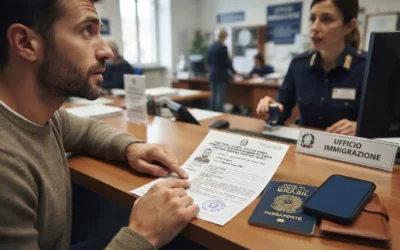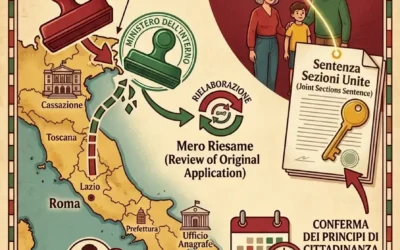

You have been recognized as an Italian citizen by an Italian court. Your children were born abroad before the 2025 reform. Yet the Comune refuses to register their birth certificates, because Law 74/2025 (often referred to online as the “Tajani decree”) says they were never Italian.
This situation is now before the EU Court of Justice. On October 2, 2026, a referral from the Tribunale di Avellino was registered in Luxembourg as Case C-1083/26 Servaso. It is the second EU Court case on Law 74/2025, after Case C-816/26 Picuso, and the first one focused specifically on children. Here is what it is about, how it differs from Picuso, and what your options are today.
The situation behind the Avellino cases
In September 2026, the Tribunale di Avellino issued two orders in cases that started the same way. Parents born abroad obtained a final judgment from the Tribunale di Napoli recognizing them as Italian citizens by descent. They then asked their ancestor’s Comune to register the birth certificates of their children, all born abroad before the reform took effect on March 28, 2025.
The Comuni (Solofra in the first case, Montoro in the second) refused. Their reasoning: under Law 74/2025, anyone born abroad who holds another citizenship is considered never to have acquired Italian citizenship, unless they meet one of the exceptions. The children’s registration was requested after the March 27, 2025 deadline, and none of the other exceptions applied.
The result is a family split in two: parents recognized as Italian from birth, and children born before the reform treated as if they had never been Italian.
The first order: back to the Constitutional Court
In the order dated September 15, 2026, the judge sent the question to the Constitutional Court. The reasoning follows a familiar line.
Under long-standing Italian case law, confirmed again by the Corte di Cassazione, citizenship by descent is acquired at birth. A court judgment or consular decision does not create it, it only confirms it. So, the judge argues, saying that these children “never acquired” citizenship has the same practical effect as taking it away retroactively.
According to the judge, this may violate the Italian Constitution on three grounds: the principle of reasonableness and the protection of legitimate expectations (Articles 2 and 3), and Article 22, which says that no one can be deprived of citizenship for political reasons.
The second order: Case C-1083/26 Servaso
The order dated September 18, 2026 goes further. It concerns four children born in Brazil between 2010 and 2025, and it sends the case to two courts at once: the Constitutional Court and the EU Court of Justice. The EU Court registered the referral on October 2, 2026, as Case C-1083/26 Servaso.
The question sent to Luxembourg relies on the EU Treaties’ rules on EU citizenship, read together with two provisions of the EU Charter of Fundamental Rights: the right to private and family life (Article 7) and the rights of the child (Article 24).
In plain terms, the judge asks whether EU law allows a country to treat people as never having been citizens when, under the rules in force at their birth, they were citizens automatically, and to do so:
- without any individual assessment of the consequences for each person;
- without any specific consideration for children, who had no say in where they were born, when their parents applied, or when their birth certificates were submitted.
The judge points out what Law 74/2025 does not allow authorities to consider: the person’s family situation, their age, their real ties with Italy or other EU countries, the concrete consequences of losing EU citizenship, and whether any delay was the fault of the parents or the administration.
Two EU Court cases: Picuso and Servaso
The EU Court was already examining Law 74/2025 in Case C-816/26 Picuso, referred by the Constitutional Court in July 2026. One of the cases joined in that referral, from the Tribunale di Mantova, involved a very similar situation: a child born in Brazil whose mother had been recognized as an Italian citizen.
So what does Servaso add? The difference is in the question itself.
In Picuso, the question is general: do the EU Treaties prevent Italy from treating people born abroad as never having acquired citizenship? The Constitutional Court did not include the Charter of Fundamental Rights. In fact, it expressly refused to ask Luxembourg about Article 7 of the Charter, holding that the point was not relevant to the cases before it.
The Servaso question puts the Charter, and the best interests of the child, at the center. The EU Court will have to say explicitly whether minors deserve special protection.
Will these challenges succeed?
Here it is worth being realistic.
The constitutional challenges face an uphill battle. The arguments based on Articles 2 and 3 of the Constitution are essentially the same ones the Constitutional Court already rejected in Judgment 63/2026. Article 22 is a new argument, but it prohibits deprivation of citizenship “for political reasons,” and it is hard to see the reform in those terms. Neither order engages with Judgment 63/2026 or Ordinanza 147/2026, which weakens them further. In my assessment, there is a real risk that the Constitutional Court will dismiss them, or wait for the EU Court’s answer before deciding.
The EU question is different. The Constitutional Court cannot dismiss it: only the EU Court can answer, and Case C-1083/26 Servaso is now formally pending in Luxembourg. How it will be handled alongside Picuso is not yet known. Under its rules of procedure, the EU Court can join related cases or wait for one before deciding another, but no decision has been made so far.
In my view, as an Italian citizenship lawyer, the strongest point of the Avellino referral is precisely the focus on minors. A child cannot be blamed for not having applied in time. Even the Constitutional Court’s reasoning in Judgment 63/2026, which relies heavily on the difference between people who “took action” and people who “remained inactive,” fits poorly with the situation of children.
What this means for families with children
If you have been recognized as an Italian citizen but your children were born abroad before the reform and have not been registered, here is what you should know.
There is a safer route available today. Children who were minors on May 24, 2025, and whose parent is an Italian citizen protected by the reform’s exceptions, can acquire citizenship through a declaration filed by their parents. The deadline for this transitional declaration has been extended to May 31, 2029. If the child turns 18 in the meantime, they can file it personally by the same date. Read also Italian citizenship: children registration deadline expired
This route does not depend on the outcome of any court case. For many families, it is the most practical solution while the courts decide.
A court challenge is a separate, longer path. Challenging the Comune’s refusal, as the families in Avellino did, may lead to a suspended case and years of waiting. It can make sense in specific situations, for example if the child does not qualify for the declaration, but it should be evaluated case by case.
Frequently asked questions
Do the Avellino orders change the law?
No. Law 74/2025 remains in force. The orders only suspend the two cases and ask higher courts to rule.
My child was born abroad before the reform. Is my child Italian?
Under current law, not automatically, unless one of the exceptions applies. But if you are a recognized Italian citizen, your child may be able to acquire citizenship through a declaration by May 31, 2029.
When will the courts decide?
There is no official timetable. On average, EU Court preliminary rulings take around 17 months, so a decision in Picuso is unlikely before late 2027. Case C-1083/26 Servaso was only registered in October 2026, and it is not yet known whether it will be decided together with Picuso or separately.