
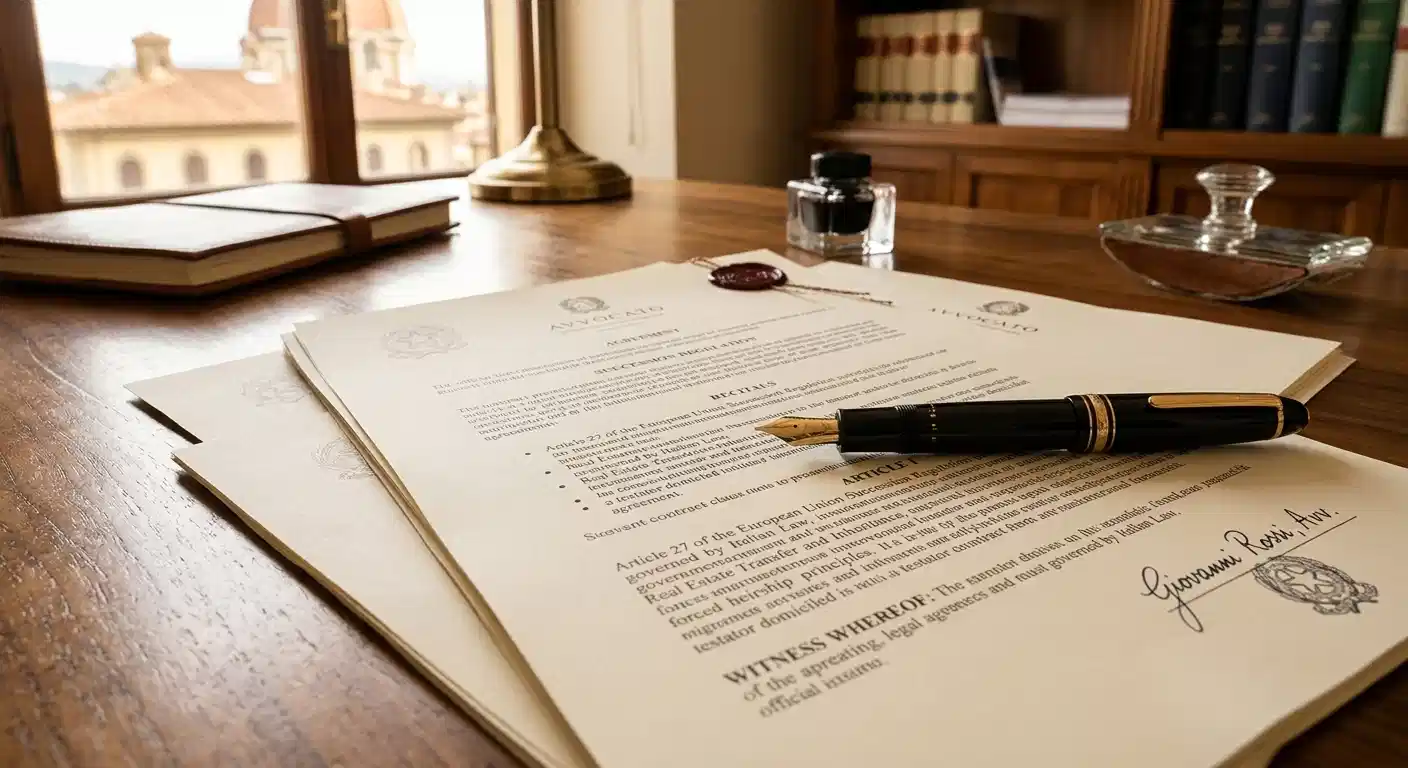
You own a house in Italy. You have a will in the United States, properly drafted and signed. So your Italian property is covered, right?
Not necessarily. A will can be perfectly valid in one country and still create serious problems when it has to work in another legal system. And you will never find out. Your heirs will, when they try to deal with the Italian notary, the bank and the land registry.
“Is my US will valid in Italy?” is really two different questions. The first is whether your will is valid as to its form. The second is which country’s law decides who inherits. The answer to the first is often yes. The second is where the problems start.
Is a US will valid in Italy as to its form?
In most cases, yes. In Italy, the formal validity of a will is governed by Article 27 of the EU Succession Regulation no. 650/2012. A written will is valid as to form if it complies with the law of any one of these:
- the country where the will was made;
- a country of which the testator was a national, when the will was made or at the time of death;
- the country where the testator was domiciled, when the will was made or at the time of death;
- the country where the testator was habitually resident, when the will was made or at the time of death;
- for real estate, the country where the property is located.
So a will made in the US in accordance with the law of your state is, as a rule, formally valid in Italy.
Language is not a problem either. A will written in English is valid. However, when it has to be used in Italy, it will need an official Italian translation.
Which law decides who inherits your Italian house?
This is the real question. The form of your will does not decide which country’s succession law applies to it. A US will does not automatically mean US law applies to your Italian property.
The EU Succession Regulation applies to deaths from August 17, 2015. It can also apply to non-EU citizens, including Americans, who leave assets in Italy. As a general rule, it says that the whole succession is governed by the law of the country where the deceased was habitually resident at the time of death.
If you live in the United States, this points to US law. But that is not the end of the story. The law of your state may have its own rules on real estate located abroad, and in some cases these rules can send the question back to Italian law for your Italian house.
The result is uncertainty: your heirs may not know in advance which law will apply to your Italian property. And if it is Italian law, it comes with forced heirship.
What is forced heirship and why does it matter?
In the United States, you are generally free to leave your estate to whoever you want. Italy works differently. Italian law reserves a minimum share of the estate to the closest family members: the spouse, the children and, in some cases, the parents. This is called the legittima. A will cannot take it away.
Some examples. If you leave a spouse and one child, one third is reserved to the spouse and one third to the child. If you leave a spouse and two or more children, one quarter is reserved to the spouse and one half to the children together. If you leave only one child, half of the estate is reserved to that child. If you leave two or more children and no spouse, two thirds are reserved to them.
Only the rest, the freely disposable share, can go to whoever you choose.
If your will does not respect these shares, the excluded heirs can go to court in Italy and claim their part.
Think of a simple case. An American leaves everything to two of his four children. He has bank accounts in the US and a house in Italy. Under US law, the two excluded children may have no claim on the bank accounts. But if Italian law applies to the house, they can claim their reserved share of it.
Need help protecting your italian property? Book a consultation
Can you choose US law for your Italian house?
Yes. The EU Succession Regulation allows you to choose, in your will, the law of your nationality to govern your entire succession. This is called professio iuris. As an American, you can choose US law. The choice must be made expressly in a will, and a handwritten Italian will can contain it.
This matters because, when you make an express choice of law, the Regulation excludes the mechanism that would send the question back to Italian law for your Italian property. In other words, a clear choice of law removes this uncertainty and can prevent the unwanted application of Italian forced heirship.
A choice of law gives certainty to you and to your heirs: your will is interpreted under one law, and future claims by unhappy relatives become more difficult.
Even if it is valid, will it work in Italy?
This is the question most people never ask. A US will can be valid in form, and still be very difficult to use in Italy.
An Italian notary, or another Italian professional, will have to examine your will, resolve any conflict between US and Italian law, and prepare the documents to transfer your property. US wills often contain trusts, references to American statutes and roles that do not exist in Italian law. On top of that, every document must be translated into Italian, and the cost of translation alone can exceed the cost of making an Italian will.
A typical problem is the executor. In a US will, you often appoint one or more people to manage and distribute the estate for the benefit of others. In Italy, the people who matter are the heirs. In practice, an Italian court may read clauses like these as something closer to a trust than to an appointment of heirs. When that happens, the people you appointed are not recognized as heirs, and selling the house can require further court proceedings.
There is also a timing problem. If your will has to go through probate in the US before it can be used in Italy, this can take months. Meanwhile, in Italy, the succession declaration must be filed within 12 months of the death.
Should you make an Italian will?
If you own property in Italy, an Italian will is usually the simplest way to protect your heirs. The most common solution is to have two wills: your US will for your assets in the United States, and an Italian will for your assets in Italy.
This works only if the two wills are drafted carefully. Each will should state that it deals only with the assets in its own country and that it does not revoke the other. Under Italian law, if you make a new will without expressly revoking the previous one, the later will overrides any provisions of the earlier one that conflict with it. A standard clause such as “I revoke all previous wills” could cancel the will you made in the other country by mistake.
Which type of Italian will?
Italian law recognizes three types of will. For foreigners, two are relevant.
The handwritten (holographic) will (testamento olografo)
It must be entirely handwritten by you, dated and signed. Typed or partly printed documents are not valid, and nobody else can write even a single word. It can be written in English, and in block letters as well as in cursive. It requires no notary and no witnesses, and it costs nothing.
Its weak point is that it can be lost, destroyed or never found. You can deposit it with an Italian notary, so that it is recorded in the General Registry of Wills (Registro Generale dei Testamenti). After your death, whoever holds it must bring it to a notary for publication: until then, it has no effect.
The notarial will (testamento pubblico)
You state your wishes to an Italian notary, in the presence of two witnesses. The notary drafts the will, reads it back to you and everyone signs. It is kept by the notary, so it cannot be lost, and it is much harder to challenge. For cross-border estates, it is generally the safer choice.
The third type, the secret will (testamento segreto), is rarely used.
What happens if you have no Italian will at all?
If there is no valid will covering your Italian property, Italian law decides who inherits, according to a fixed order. For example, a spouse and one child share the estate equally; a spouse and two or more children receive one third and two thirds.
An unmarried partner inherits nothing, however long you have lived together.
What about inheritance tax?
Your heirs will also have to deal with Italian inheritance tax on your Italian assets. If you were not tax resident in Italy, the tax applies only to assets located in Italy. The rates are among the lowest in Europe: spouses and children pay 4% only on the amount exceeding €1 million each, while siblings pay 6% on the amount exceeding €100,000. Other relatives up to the fourth degree pay 6%, and everyone else pays 8%, with no allowance.
For real estate, there are also mortgage and cadastral taxes, calculated on the cadastral value of the property (property tax in Italy for foreigners).
Check now, not later
A US will can be valid in Italy and still leave your heirs with delays, court proceedings and costs. A coordinated Italian will, even a very simple one, can avoid most of these problems.If you own a house in Italy (what Americans should know about buying property in Italy) and have only a US will, it is worth having it reviewed by an Italian lawyer now, while you can still change it. For general information on succession rules in Italy, see also the European Commission’s e-Justice page on succession in Italy.