
Choosing to rent a property in Italy without an agent is a savvy financial move—you save the standard agency fee (usually one month rent plus 22% VAT)—but it shifts the entire burden of legal due diligence onto your shoulders. As a lawyer, I often see tenants who saved €2,000 on agency fees only to lose €5,000 in security deposits or illegal “extra” charges.
This guide provides the tactical and legal framework to rent privately while staying fully protected.
Pre-Contractual Diligence: Avoiding the “Fake Landlord”
When there is no agency to verify the parties, the risk of scams increases exponentially. In 2026, sophisticated “digital” scams are common.
Verify Ownership (The Visura Catastale)
Never sign a contract or transfer a “holding deposit” without seeing a Visura Catastale. This document, issued by the Agenzia delle Entrate, proves who actually owns the property.
- The Trap: A “landlord” who claims to be abroad and asks for a transfer via Western Union or Airbnb-spoofed links.
- The Legal Check: Ensure the names on the Visura match the ID of the person signing. If the property is owned by a company (Società), verify that the person signing has the power of attorney.
The “Proposta d’Affitto”
Even in private deals, you might be asked to sign a “proposal” and leave a small sum. Ensure this document specifies that the sum is a “deposito fiduciario” and must be fully refunded if the landlord rejects your application.
Navigating Italian Rental Contracts (Law 431/98)
Italy does not have a “one size fits all” rental agreement. The Law 431/98 strictly regulates the types of contracts allowed. Using the wrong one can jeopardize your right to stay or your residency.
The 4+4 (Contratto Libero)
The most common choice for long-term expats. It lasts four years and automatically renews for another four.
- Pros: Stability.
- Cons: Rent is set by the market and can be high.
The 3+2 (Contratto a Canone Concordato)
The rent is not decided by the landlord but is capped based on local agreements between unions and the municipality.
- Why it’s better: It is usually significantly cheaper than a 4+4.
- Legal Tip: These contracts must be assisted or certified by a tenant/landlord union to be valid. As an expat, always ask if the rent is “concordato” to save money.
The Transitorio (Short-Term)
Valid from 1 to 18 months.
- The Strict Rule: You cannot just sign this because you want a short stay. There must be a justified reason (e.g., a temporary work contract, a specific master’s degree) attached to the contract. If the reason is missing or false, the contract can be legally converted into a long-term 4+4 by a judge.
The Security Deposit: Your Rights & The Law
Most disputes in Italy involve the deposito cauzionale (Law 392/78). Here is what you must know:
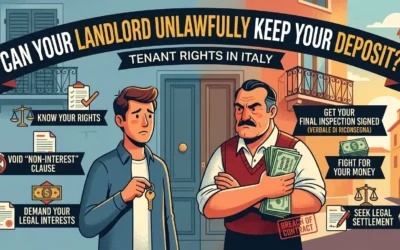
- The Interest Myth: Landlords often claim the deposit is “non-interest bearing.” This is illegal. By law, your deposit always earns annual interest. Any clause stating otherwise is null and void; you are entitled to the full accumulated sum when you move out.
- Damages vs. Rent: A landlord cannot unilaterally deduct money for damages (like scratches or wear) without your consent or a judge’s order. However, if you have unpaid rent, the debt is considered certain and liquidated, allowing the landlord to legally withhold the deposit to cover the specific arrears.
Note: For a deeper look at how to handle these disputes and ensure your money is returned, check out our full guide on recovering your security deposit here
Residency (Residenza) and the Contract
For expats, a registered contract is not just about a roof; it’s about your legal status in Italy.
To apply for residency (iscrizione anagrafica), you must present a registered rental contract.
- “Contratto in Nero” (Unregistered): If the landlord refuses to register the contract to avoid taxes, you cannot get residency, you cannot get a family doctor (ATS), and you cannot buy a car or open certain bank accounts.
- The Law: Every contract longer than 30 days must be registered at the Agenzia delle Entrate. The cost is usually split 50/50, but if the landlord uses Cedolare Secca (a flat tax regime), registration is free.
Utilities: The “Voltura” Process
When renting privately, you will likely need to handle the utilities yourself.
- Voltura: This is the transfer of an existing contract from the landlord’s name to yours.
- Subentro: This is activating a meter that has been deactivated.
- Hidden Costs: Always check for unpaid utility bills left by the previous tenant. Legally, you are not responsible for their debts, but providing proof to the energy companies can be a bureaucratic nightmare. Take photos of the meters on the day you receive the keys!
Maintenance: Who Pays for What?
Disputes often erupt over a broken boiler or a leaking pipe. Italian law is clear:
- Ordinary Maintenance: The tenant pays (e.g., annual boiler service, broken shutters, light bulbs, minor repairs).
- Extraordinary Maintenance: The landlord pays (e.g., replacing the boiler, structural repairs, roof leaks, old plumbing failure).
The Strategy for a Safe Exit: The Settlement Agreement
If you need to leave the apartment earlier than the notice period (usually 6 months), don’t just walk away. As an attorney, I recommend drafting a Settlement Agreement (Accordo Transattivo). This document confirms:
- The date the keys are returned.
- The exact amount of the deposit being returned (including interests).
- A “tombstone” clause stating that neither party has any further claims against the other.
This prevents the landlord from suing you months later for “hidden damages.”
.