Buying property in Italy as a non-resident is far more legally complex than in many other Western countries. Italians grow up understanding the system’s nuances, informal networks, and unwritten rules. Foreign buyers operate outside this ecosystem, which makes professional guidance essential.
This guide covers the 10 legal pitfalls that catch foreign buyers off guard — from hidden building violations to inheritance traps, cadastral tax surprises, and dangerous contractual obligations. Each section acts as a checklist to help you navigate the most common pitfalls when buying a house in Italy.
“An ounce of prevention is worth a pound of cure.” Hiring a property lawyer in Italy for full transaction support is not as expensive as you might think — contact us for a quote.
Pitfall #1: The real estate agent’s dual interest
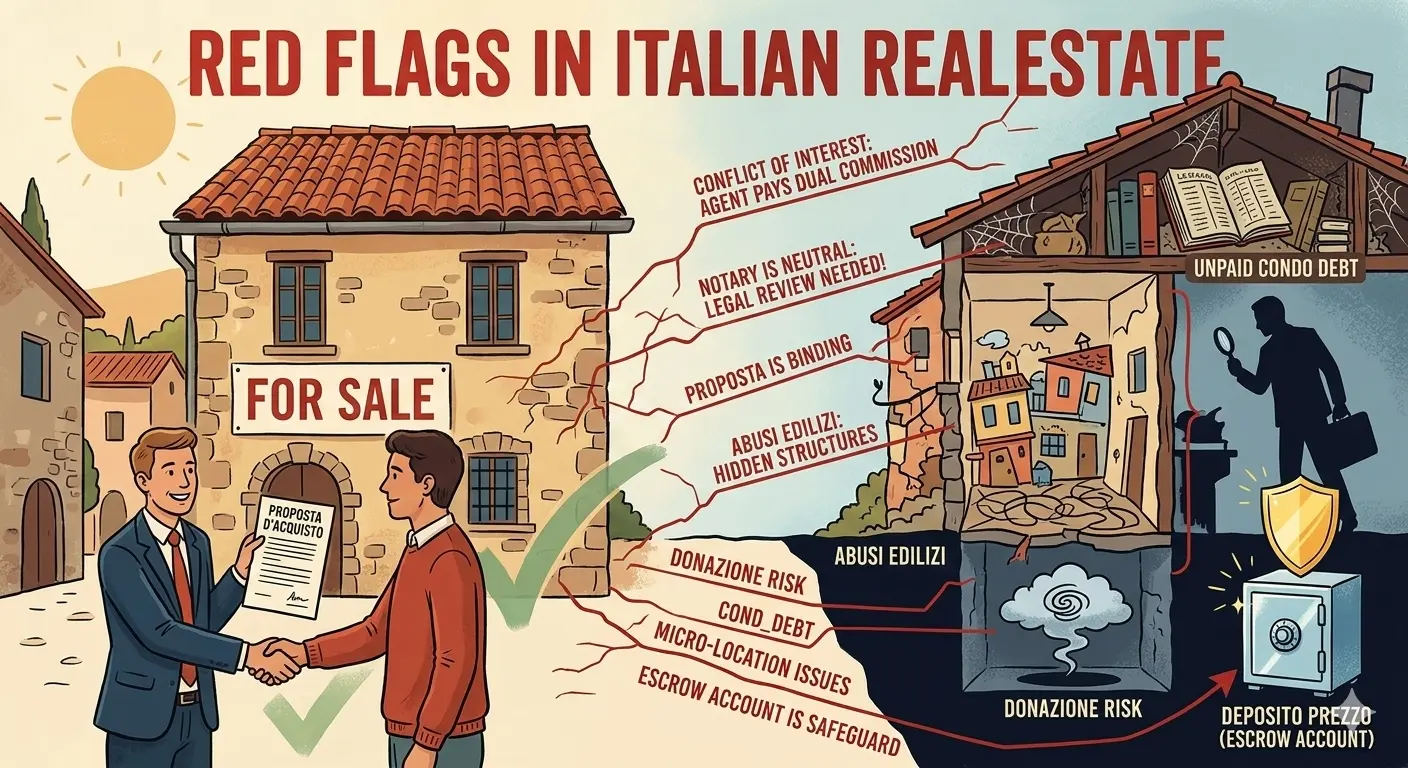
In Italy, the real estate agent acts as a mediatore (mediator), not as your exclusive representative. They legally collect a commission from both the buyer and the seller, which creates an inherent conflict of interest. Their primary incentive is to close the deal — not to protect your investment.
Pitfall #1: The real estate agent’s dual interest
In Italy, the real estate agent acts as a mediatore (mediator), not as your exclusive representative. They legally collect a commission from both the buyer and the seller, which creates an inherent conflict of interest. Their primary incentive is to close the deal — not to protect your investment.
Pitfall #2: The notary is not your lawyer
A common misconception among foreign buyers is assuming the Notaio (Notary) works in their interest. In Italian law, the Notary is a neutral State official whose role is to authenticate the deed and ensure its formal legality. They will not alert you to risky clauses, unfair terms, or hidden risks in the transaction. Neutrality does not equal protection.
⚠ Action required: Hire a licensed Italian property lawyer who works exclusively for you.
Pitfall #3: The binding purchase offer (Proposta d’Acquisto)
In many countries, a purchase offer is simply an expression of interest. In Italy, however, the Proposta d’Acquisto can have immediate legal consequences.
The purchase proposal is usually the first formal document signed when a buyer decides to move forward with a property. It is often prepared by the estate agent and includes key information such as:
- Identity of the buyer and seller
- Property details
- Proposed purchase price
- Deposit (caparra confirmatoria)
- Timeline for the transaction
- Any conditions required by the buyer
What many international buyers do not realize is that once the seller accepts the proposal, the document becomes legally binding. This means the buyer may already be committed to completing the purchase. If the buyer withdraws without a valid contractual reason after acceptance, they may lose the entire deposit.
⚠ Legal tip: A Proposta d’Acquisto should never be signed without legal review. The conditions included in this document will determine how much protection the buyer actually has.
Pitfall #4: Automatic conversion into a preliminary contract (Compromesso)
Another aspect that surprises many foreign buyers is that some purchase proposals automatically become a preliminary contract once accepted. This depends on how the proposal is drafted.
Many real estate agencies use standard templates containing clauses stating that the accepted proposal already constitutes a binding preliminary agreement (compromesso). In practice, this means:
- The parties are already legally committed to the transaction
- The essential terms of the sale are already fixed
- There may be no separate negotiation phase before the preliminary contract
For buyers unfamiliar with the Italian system, this can come as an unexpected commitment.
When the estate agent’s commission becomes due
Under Italian law, the agent becomes entitled to receive their commission when the buyer and seller reach agreement on the essential terms of the transaction. In many cases, this moment occurs when the purchase proposal is accepted. This means that after acceptance:
- The buyer may already be legally bound to proceed
- The deposit may become payable to the seller
- The agent’s commission may already be due
— even though the preliminary contract (compromesso) or the final deed (rogito) may be signed later. For international buyers, this timing can be surprising.
Pitfall #5: Building and urbanistic violations (abusi edilizi)
This is the single most common issue in Italian real estate transactions, especially in Southern Italy and rural areas. Illegal modifications — such as moved walls, added terraces, or unauthorized windows — are widespread. When you purchase a property, you legally inherit all pre-existing violations and the full responsibility, both legal and financial, to regularize or remove them.
If you are paying in cash, they might suggest that these issues are not an immediate concern. However, if you plan to resell the property in the future, a buyer may need a mortgage. Unresolved violations could prevent them from obtaining financing, potentially complicating the sale or affecting the resale price.
Pitfall #6: Inherited property via donation (Donazione) risk
If the seller originally received the property as a gift (donazione), Italian law gives the donor’s heirs the right to challenge that gift for up to 20 years after the donor’s death. This creates a cloud on the title that can make the property unmortgageable and extremely difficult to resell.
⚠ Always check whether the seller’s title originates from a donation. If yes, consult with a lawyer.
Pitfall #7: The building matters as much as the apartment
This is one of the aspects that surprises foreign buyers the most. In Italy, purchasing a property rarely means buying only the apartment. In most cases, you are also becoming part of a condominio — a shared building structure where owners collectively manage maintenance, expenses, and major decisions affecting the property.
A proper evaluation usually requires reviewing several elements that go far beyond the individual unit, such as:
- The condominium regulations and meeting minutes
- Past building works and any renovations already approved
- Upcoming extraordinary maintenance costs
- The financial situation of the condominium
- Potential structural or legal issues affecting the building
A beautifully renovated interior does not necessarily reflect the condition of the building as a whole. If major works are required — such as façade restoration, roof repairs, or elevator replacement — the costs are shared among all owners and can be significant.
Pitfall #8: Unpaid condominium debt
Under Italian condominium law (art. 63 of the Disposizioni attuative del Codice Civile), the buyer of an apartment in a condominium becomes jointly liable with the seller for any unpaid condominium fees from the current year and the previous year. Without a formal written declaration from the condominium administrator (amministratore di condominio) certifying zero outstanding debts, you risk inheriting thousands of euros in charges.
⚠ Request the declaration of no condominium debts before the deed is signed.
Pitfall #9: Price negotiation and micro-location
Real estate prices in Italy are generally negotiable relative to their listing price. Factors that can influence the final price include the condition of the property, cadastral conformity, whether it derives from a donation, how quickly payment will be made, how long the property has been on the market, and its location.
Beyond price, micro-location matters enormously. Within the same district, factors such as street exposure, floor level, natural light, noise levels, the presence of an elevator, or the condition of common areas can dramatically affect both value and long-term desirability. Two properties advertised at the same price per square meter may represent very different opportunities — differences that only become clear through on-the-ground familiarity with the local market.
Pitfall #10: The safety of escrow payments (deposito prezzo)
If there is a real possibility of issues, such as undisclosed debts, mortgages, or legal claims against the seller, creditors could theoretically seize the property between the signing of the deed and its registration.The Italian Deposito Prezzo (Notary Escrow Account) can protect you. When used, the notary holds your funds securely until the deed is fully registered, transferring them to the seller only afterward, thereby safeguarding your investment