
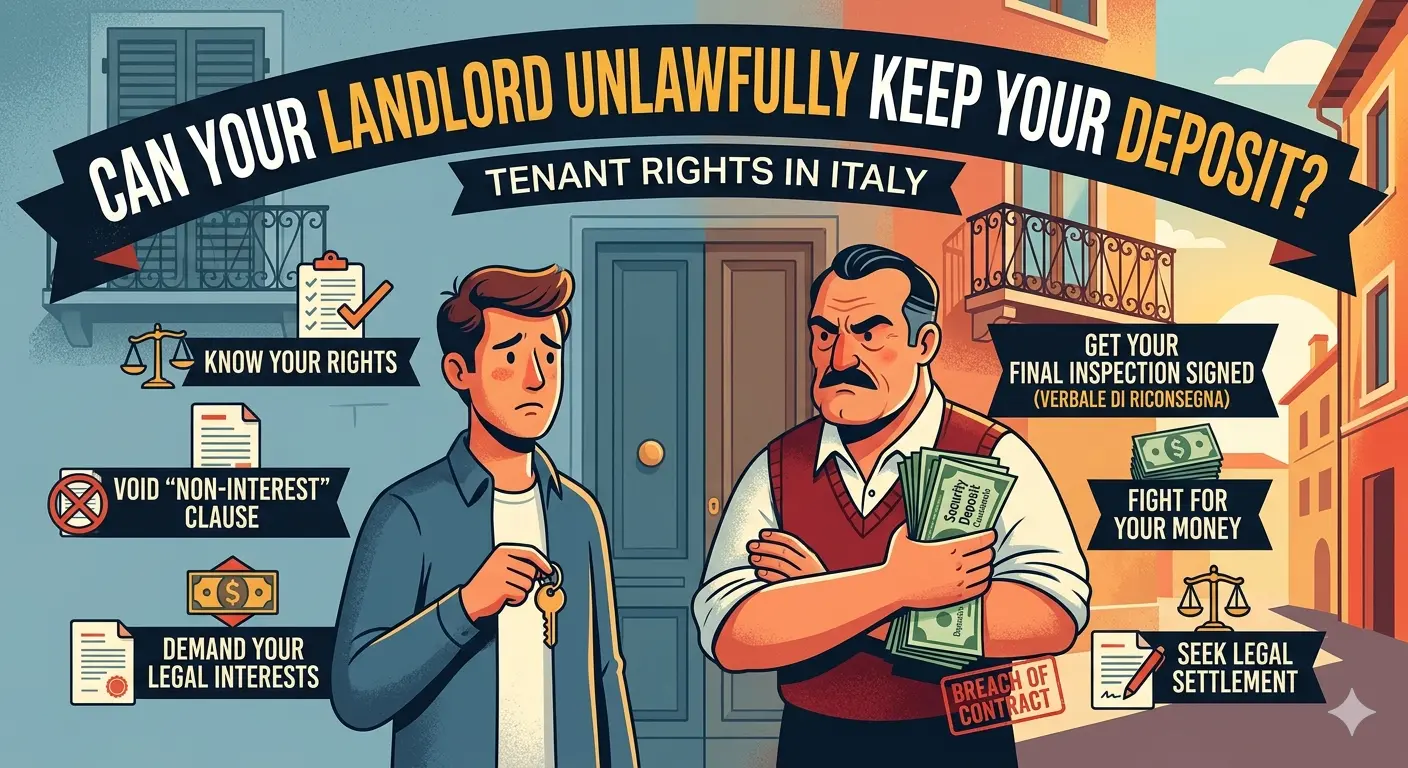
Security Deposit in Italy: A Guide for Tenants
In Italy, the security deposit (deposito cauzionale) is a sum of money paid by the tenant to the landlord at the start of a lease. Its purpose is to protect the landlord against potential damages to the property or unpaid rent. However, its use is strictly regulated by Law 392/78 to prevent abuses.
Key Rules at a Glance
- Maximum Amount: By law (Art. 11, Law 392/78), the deposit cannot exceed 3 months’ rent.
- Interest: The deposit always earns legal interest. Even if the contract says “non-interest bearing,” that clause is null and void. Generally, these interests are calculated and paid back to the tenant in a lump sum at the end of the lease.
- Return Policy: The landlord must return the deposit immediately after the final inspection (verbale di riconsegna) is signed, provided there are no damages.
Can the landlord keep the money?
If there are damages (such as broken walls or ruined furniture), the landlord cannot unilaterally decide how much to keep and “offset” from your deposit. Since damages are subjective and require professional valuation, there must be a mutual agreement between you, or the landlord must seek a judge’s order to prove the repair costs.
Normal Wear and Tear vs. Actual Damages A frequent point of conflict is “normal wear and tear” (normale deperimento d’uso). Under Italian law, a tenant is not responsible for the natural aging of the property. For instance, small holes in the walls from picture frames or slightly darkened paint after a long-term lease are considered normal wear and tear. The landlord cannot use your security deposit to “refresh” the apartment for the next tenant at your expense. The deposit is reserved for actual damages, not for routine maintenance that remains the owner’s responsibility.
Can the landlord keep your deposit if you struggle with rent?
If you are unable to pay a month’s rent, telling your landlord to “just keep the deposit” is technically a breach of contract. In Italy, the deposit is a safeguard against property damage, not an advance on rent. Legally, a landlord can still claim the rent and potentially start an eviction process (sfratto per morosità) if the payment is more than 20 days late.
The real danger: “Double withholding”
If you move out with unpaid rent, the landlord will inevitably offset the debt using your deposit. This is because unpaid rent is considered a certain, liquidated, and due debt (certo, liquido ed esigibile), which legally allows the landlord to apply the offset more easily than for damages.
The real risk arises when a landlord tries to keep the money for both unpaid rent and alleged damages without proof. Your main defense is the “verbale di riconsegna” (the final inspection document). Without this signed paper, it becomes much harder for the landlord to justify withholding your money for anything other than the clearly documented unpaid rent.
The “No-Interest” Myth
Most Italian landlords insert a clause saying “the deposit does not earn interest.” This is illegal. By law, the security deposit always earns annual legal interest. This interest must be paid to the tenant every year or, more commonly, accumulated and paid back in a full lump sum at the end of the lease. Any agreement to waive these interests is null and void.
Damage Deductions vs. Unpaid Rent
It is essential to distinguish between these two scenarios:
- For Damages: The landlord cannot unilaterally decide that a scratch on the floor costs €500 and deduct it. If you disagree, only a judge can determine the value. This is why the landlord cannot “offset” damages without your consent.
- For Unpaid Rent: If you leave with arrears, the debt is considered certain, liquidated, and due (certo, liquido ed esigibile). In this case, the landlord has the legal right to withhold the deposit to cover the specific debt of the rent, as the amount is mathematically certain
When should the deposit be returned?
Technically, the deposit must be returned immediately upon the termination of the lease and the handover of the keys, provided the final inspection report is signed and shows no damages. If the landlord delays the payment without a valid legal reason, you are entitled to claim the sum plus any accrued legal interest. If 30 days pass without a refund or a formal notification of damages, it is advisable to involve a lawyer to send a formal demand.
The strategy: negotiate a settlement
If you are leaving an apartment with rent arrears, the best move is to negotiate a written settlement agreement. This document ensures:
- The deposit is officially used to cover the debt.
- All further claims (damages) are closed.
- You are protected from future legal actions or requests for “repairs” that weren’t your fault.
What to do if your deposit is withheld
If your lease has ended and you haven’t received your money back:
- Send a formal notice (Lettera di messa in mora) via PEC or registered mail (A/R).
- Seek legal advice to file for an injunction (decreto ingiuntivo).